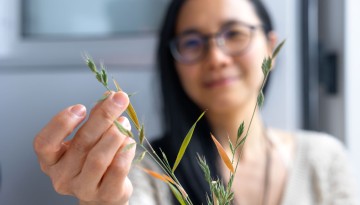
Two faculty members – one studying killer fungi and the other using yeast to find safer painkillers – are winners of Schwartz grants, given annually to female faculty or faculty who enhance the diversity, equity and inclusion goals of the university.
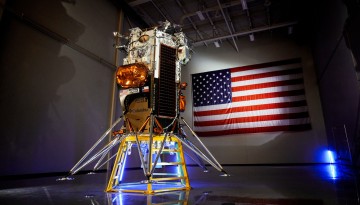
With the help of a Cornell researcher, the first radio telescope ever to land on the moon will lay the foundation for detecting habitable planets in our solar system by observing Earth as if it’s an exoplanet.
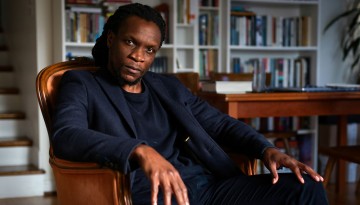
In the new book-length work, “School of Instructions: A Poem,” Ishion Hutchinson writes of the psychic and physical terrors of West Indian soldiers volunteering in British regiments in the Middle East during World War I.
The U.S. National Science Foundation has awarded the Cornell High Energy Synchrotron Source $20 million to build a new precision X-ray beamline for research on biological and environmental systems.
People with stronger negative implicit judgments about a partner are more likely to perceive negativity in daily interactions with them, which hurts relationship satisfaction over time, Cornell psychology research finds.
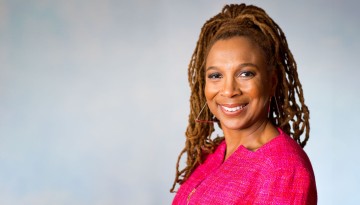
This year’s Martin Luther King, Jr. Commemorative Lecture on Feb. 19 will focus on the importance of understanding and addressing systems of oppression and their impact on multiple identities, including race and gender.
Convening of 80 leaders, researchers and staff across six colleges discussed strategies to address climate change mitigation, adaptation and societal transformation, in a Feb. 1 roundtable sponsored by The 2030 Project.