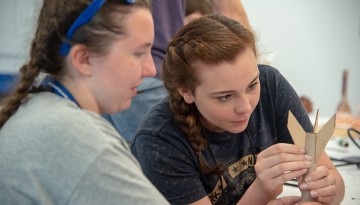
More than 500 middle and high school students from across New York gathered at Cornell’s Ithaca campus June 26-28 to participate in workshops taught by Cornell faculty, staff and graduate students during the annual 4-H Career Explorations conference.
Thirteen students participating in the Ronald E. McNair Post-Baccalaureate Achievement Program at Cornell traveled to Washington, D.C., June 28 to advocate for federal programs assisting first-generation and low-income college students.
Erie County officials shared initiatives focused on sustainability and economic growth, quality of life and building strong communities with faculty at a recent roundtable.
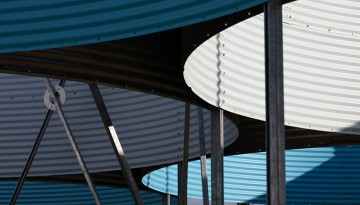
Connecting upstate and downstate, urban and rural, a pavilion made from reused metal grain bins opened to the public June 23 on Governors Island in lower New York Harbor. Four Cornell faculty members collaborated on the project with a team including students and alumni.
Meredith Silberstein, assistant professor in the Department of Mechanical and Aerospace Engineering, will receive $150,000 a year over the next five years through a Department of Energy early-career program.
Doctoral students in Cornell Engineering’s Commercialization Fellowship are developing tools to compress laser pulses, separate blood plasma and 3D print living tissue.
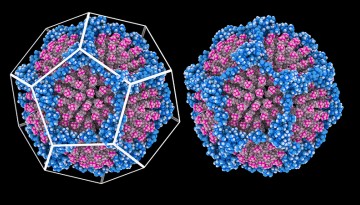
A cross-campus collaboration led by materials science professor Uli Wiesner results in visual confirmation of 12-sided, nanoscale cage structures, which could have medical diagnostic and therapeutic applications.
A group led by chemical engineering professor Lynden Archer and Snehashis Choudhury, Ph.D. '18, proposes a new way to think about the electrolyte structure of a lithium metal battery.
Ilana Brito, assistant professor of biomedical engineering, has been named a Pew Scholar in the Biomedical Sciences. Brito will receive a four-year, $300,000 grant to further her study of the human microbiome.