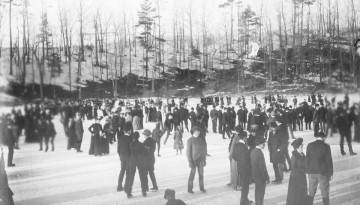
In the late 19th century, Cornell students enjoyed visually striking class lectures and extracurricular talks thanks to lantern slides – 4-by-3.25-inch projected glass slides that illustrated all subjects.
Three young Cornell researchers have won National Institutes of Health New Innovator Awards. The awards provide up to $1.5 million over five years for innovative, high-impact projects.
Cornell Engineering celebrates its legacy of leadership and innovation weekend of sesquicentennial celebration events Oct. 23-24 with panels and festivities throughout the weekend.
While the EPA suggests a decline in measurable atmospheric greenhouse gas emissions from fossil fuel use in the United States, a Cornell scientist says the agency's computation may be in error.
A new lightweight and stretchable material with the consistency of memory foam has potential for use in prosthetic body parts, artificial organs and soft robotics.
Cornell physicists offer a solution to control the intrinsic spin of electrons: Using heat, instead of light, to measure magnetic systems at short length and time scales.
From Buffalo to Long Island, the North Country to the Southern Tier, Cornell undergraduates – serving as interns – spent their summer enhancing life in New York.
Eight faculty members from four colleges were honored recently with awards from the Louis H. Zalaznick Teaching Assistantship program, allowing them to expand courses or add teaching assistants.
Will Dichtel, associate professor of chemistry and biochemistry, whose innovations may allow for ample electricity and for detecting trace amounts of explosives, has received a 2015 MacArthur Foundation Fellowship.