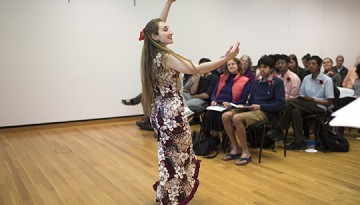
A celebration of National Poetry Month and language learning April 21 featured multilingual poetry, song, dance and an international dessert reception.
More than 200 Cornell undergraduate and graduate students joined 40,000 scientists and boosters to champion knowledge in the first March for Science in Washington, D.C., April 22.
Researchers show that coating the anode of a lithium-oxygen fuel cell with bromide results in more stable charging and could represent a step toward practical lithium-oxygen energy storage technology.
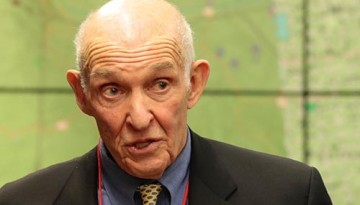
Industry leaders, academics and former students gathered April 12 in San Francisco to celebrate Donald P. Greenberg ’55, Cornell’s Jacob Gould Schurman Professor of Computer Graphics.
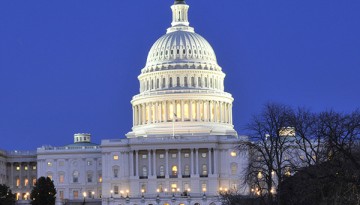
Faculty will share ideas on climate change April 21-23 at the Smithsonian's Earth Optimism Summit, while students ascend Capitol Hill on April 21, and then walk in the national Science March on April 22.
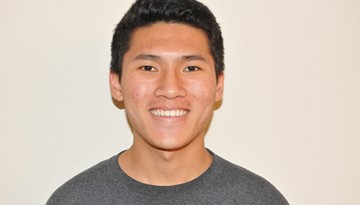
Allen Jiang '18, a chemical engineering major from Redmond, Washington, has won a 2017 Goldwater Scholarship, which recognizes top undergraduates in mathematics, the natural sciences and engineering.
Applications of digital technology from academic disciplines across campus will be exhibited April 19 at the annual BOOM (Bits on Our Minds) exhibition.
Two dozen teams competed in Cornell's fourth annual high school programming contest, with a team from Ithaca solving the most problems in the least time to take the trophy.