Graduating members of the Tri-Service Brigade received commissions to begin their military service – including the brigade’s first commission into the U.S. Space Force – at a May 26 ceremony in Statler Auditorium.
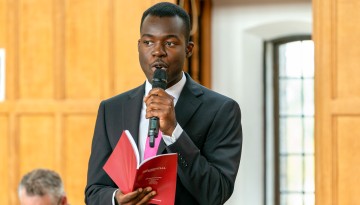
In a two-day celebratory program, Merrill Scholars recognized the high school teacher or mentor who most impacted their early education and the Cornell faculty or staff member who contributed most significantly to their college experience.
Cornell Atkinson will provide $1.6 million in seed funding to support research teams across nine colleges and 22 departments, many with external partnerships.
Julián Castro, former U.S. Secretary of Housing and Urban Development, and former Congressman Tom Davis (R-Virginia) will serve as the inaugural John W. Nixon ’53 Distinguished Policy Fellows at the Cornell Jeb E. Brooks School of Public Policy.
Generative artificial intelligence threatens to undermine trust in democracies when misused, but may also be harnessed for public good, Sarah Kreps told the President’s Council of Advisors on Science and Technology on May 19.
A new biotech and pharmaceutical management program offered through the Cornell Jeb E. Brooks School of Public Policy will allow students to explore industry trends and cutting edge research with a cohort of peers, executives and renowned faculty from the university.
A new pre-college certificate program designed to help high school students develop data analysis skills complementary to a wide range of academic and professional fields will be offered at no cost to the children of Cornell faculty and staff and underserved students nominated by local high schools and other partners.
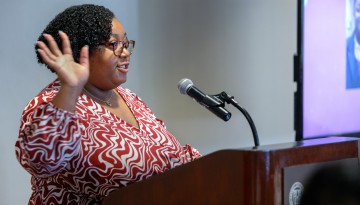
An enthusiastic audience of 100 Cornellians celebrated academic achievements and community at the Office of Academic Diversity Initiatives’ annual Honors Award Ceremony on May 5.