Amy Somchanhmavong, Ithaca Asian American Associations, gives a local perspective on anti-Asian/Pacific Islander bias, and discusses the "Virus has no nationality campaign."
Farther Farms has created the world’s first commercially available french fries that don’t need freezing or refrigeration, with innovative technology developed at Cornell.
Cornell Alliance for Science Director Sarah Evanega, Ph.D. ’09, is recognized for her outstanding achievements working for the advancement of science in the public policy arena.
More than a hundred people gathered virtually at the end of April for the 2021 annual conference on the CCAT-prime project, which is building the Fred Young Submillimeter Telescope (FYST) in Chile. “First light” is scheduled for 2023.
More than 30 students presented their research on a wide range of topics during the 35th Cornell Undergraduate Research Board Spring Symposium, held virtually May 4-7.
Michael L. Thonney, professor in the Department of Animal Science and director of graduate studies in the field of Animal Science, died April 23 in Ithaca. He was 71.
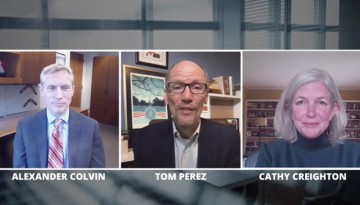
The course of labor could change dramatically during the Biden administration. On Monday, former U.S. Secretary of Labor Thomas Perez and ILR School Dean Alex Colvin discussed what’s at play.
More than 900 viewers tuned in on May 4 to hear Cornell alumni and industry experts representing both management and workers discuss whether U.S. employers should require their employees to be vaccinated.
The College of Engineering will grow the number of students it invites to its CATALYST Academy – a program aimed at inspiring minority students to study engineering – thanks to a $2 million gift from Peter Wright ’75, MBA ’76.