New Cornell-led research analyzes the notion of “swing” voters and develops a more general approach to identifying “pivotal components,” which are applicable to a wide range of systems.
An analysis of high-speed raindrops hitting biological surfaces such as feathers, plant leaves and insect wings reveals how these highly water-repelling veneers reduce the water’s impact.
Lynden A. Archer, the James A. Friend Family Distinguished Professor in Engineering, has been named the Joseph Silbert Dean of Engineering for a five-year term beginning July 1.
New smart parking software developed by Cornell researchers could reduce congestion and emissions while saving drivers the time of circling to look for available spots.
A team of Cornell students found an artful way to snare the sun’s energy and optimize it for the U.S. Department of Energy’s inaugural Solar District Cup collegiate design competition.
Cornell researchers have demonstrated a technique for writing, erasing and rewriting microscopic magnetic patterns – think the world's tiniest Etch A Sketch – that could advance research into ultrafast computer memory.
New research from Hening Lin, professor of chemistry and chemical biology in the College of Arts and Sciences, finds that a protein called TiPARP acts as a tumor suppressor.
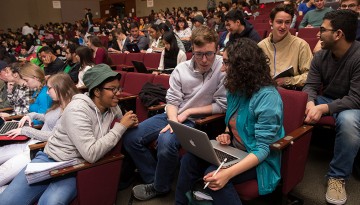
Men participated more in an active learning STEM course, while women reported lower perceptions of their scientific abilities and more likely to feel judged based on gender, a new Cornell-led study has found.
Cornell researchers combined genetic engineering, single-molecule tracking and protein quantitation to get a closer look at how living bacteria identify – and then build resistance to – toxic chemicals and metals. The knowledge could lead to the development of more effective antibacterial treatments.