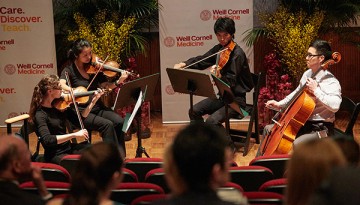
In events held at the College of Agriculture and Life Sciences and at Weill Cornell Medicine March 17, students, faculty and staff paid tribute to Cornell's late preside, Elizabeth Garrett.
Dr. Sing Sing Way, associate professor of pediatrics at the University of Cincinnati College of Medicine, was awarded the inaugural Gale and Ira Drukier Prize in Children's Health Research March 17.
A $24 million grant from the Bill & Melinda Gates Foundation will expand the scope of a global partnership to combat climate-change-induced heat stress and disease pathogens in crops.
New research from Weill Cornell Medicine identified "good" or "commensal" bacteria that inhabits human and mouse immune cells and appears to protect the body from inflammation and illness.
Food science professor Dr. Rui Hai Liu won the 2016 General Mills Bell Institute of Health and Nutrition Innovation Award for his contributions to cereal grain and grain component research.
Genetic cues from male mosquitoes passed on during sex affect which genes are turned on or off in females post-mating, offering clues for controlling mosquitoes that carry diseases.
On March 8, Dr. Laurie Glimcher, dean of Weill Cornell Medicine, announced the launch of the President Elizabeth Garrett Fund for Colon Cancer Research.
A $5 million grant from the Bill & Melinda Gates Foundation to Cornell will train agricultural researchers from sub-Saharan Africa in the theory and practice of gender-responsive research.
Home births increased by 80 percent from 2009-2014, but they present a small but significant risk to the health of the mother and baby, according to new research by Weill Cornell Medicine.