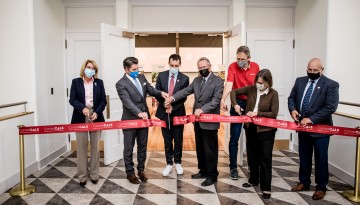
A $3.5 million renovation of Jordan Hall on the Cornell AgriTech campus will enable more distance-learning opportunities for entrepreneurs and workers in New York state’s food and farm economy.
Dr. Norman Sharpless, director of the National Cancer Institute at the NIH, will give this semester’s Distinguished Lecture in Cancer Biology Sept. 24 from noon-1 p.m.
Cornell researchers and students are poised to help shed light on the history of St. James A.M.E. Zion Church, the world’s oldest active A.M.E. Zion Church.
With moments of silence and the tolling of chimes, the Cornell community solemnly observed the 20th anniversary of the Sept. 11, 2001, terrorist attacks, which killed nearly 3,000 people, including 21 alumni.
At this year’s International Conference on Functional Programming (ICFP 2021), the article that announced the network programming language—called Frenetic—at the 2011 meeting was feted as its “Most Influential Paper.”
From online yoga teacher certification to a socially equitable real estate development company, the Johnson Summer Startup Accelerator graduated its newest cohort of innovative startup founders this summer.
Recent doctoral graduates Sadia Shirazi, Ph.D. ’21, and Dexter Lee Thomas, Ph.D. ’20, have been named Emerging Voices Fellows by the American Council of Learned Societies.
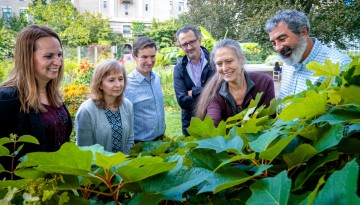
The new Center for Research on Programmable Plant Systems, or CROPPS, funded by a five-year, $25 million National Science Foundation grant, aims to grow a new field called digital biology.
Most of the members of Cornell’s Class of 2023 were infants when the terror attacks of Sept. 11, 2001 occurred. This fall,20 of them are exploring that time period in a new class, “Afterlives of 9-11.”
The National Institutes of Health has awarded a $26.5 million grant to a group that includes Weill Cornell Medicine, which aims to both silence and permanently remove HIV from the body.
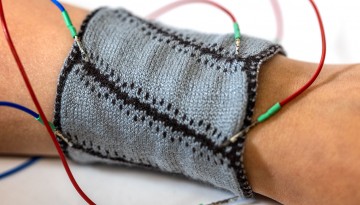
Cindy Hsin-Liu Kao, assistant professor in the College of Human Ecology, uses knitting and weaving techniques to make on-skin devices that express the wearer’s personality.