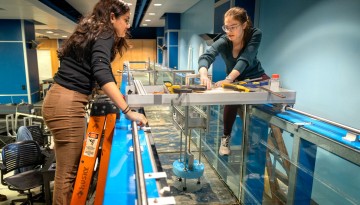
Two Cornell Engineering undergraduates are working to make arrays of wave energy converters – devices catch the waves and turn them into electricity – and move the technology closer to actuality.
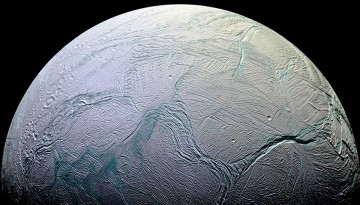
Decades before any probe dips a toe – and thermometer – into the waters of distant ocean worlds, Cornell astrobiologists have devised a way to determine ocean temperatures based on the thickness of their ice shells, effectively conducting oceanography from space.
Male teaching assistants are more likely to receive higher ratings than their female counterparts, and both genders are perceived as more valuable when exhibiting traits historically associated with their respective roles in society, a Cornell study finds.
Researchers studying large-scale artificial intelligence, microbial biomanufacturing and causal inference methods are among the Cornell researchers who recently received National Science Foundation Faculty Early Career Development Awards.
Faculty, staff and community partners are working together to address community needs — and they’re getting students involved with support from Engaged Opportunity Grants from the Einhorn Center for Community Engagement.
Thorsten Joachims and Andrew Myers, two faculty members in the Cornell Ann S. Bowers College of Computing and Information Science and leading researchers in the field of computer science have each received named professorships.
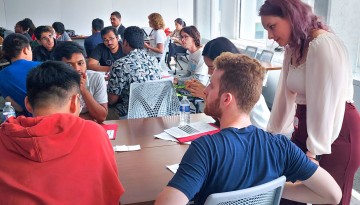
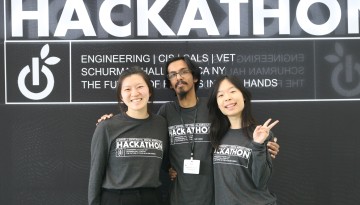
More than 120 students took part in the Digital Agriculture Hackathon, sponsored by the Cornell Institute for Digital Agriculture and Entrepreneurship at Cornell.
William B. Streett, who was recognized for changing the culture of undergraduate studies as dean of Cornell Engineering, died Feb. 5 in Cincinnati. He was 92.
Assistant professors Anna Y.Q. Ho, Chao-Ming Jian, Rene Kizilcec and Karan Mehta are among 126 early-career researchers who have won 2024 Sloan Research Fellowships from the Alfred P. Sloan Foundation.