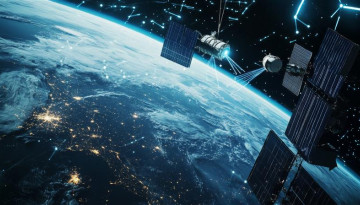
Gregory Falco, assistant professor, has received a Young Investigator Program award from the Air Force Office of Scientific Research to investigate autonomous spacecraft that can maintain coordination while an adversary is trying to disrupt them.
A National Science Foundation grant will support Cornell research aimed at developing AI models that can better represent human decision-making in cyber-physical systems while remaining interpretable and explicit about uncertainty.
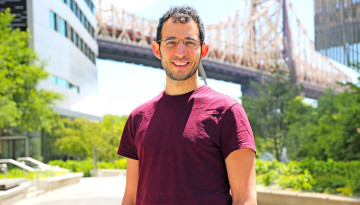
Makora, a startup founded by assistant professor Mohamed Abdelfattah, has received a $1.75 million award from the National Science Foundation-supported STRIDE Ventures AI Efficiency Challenge.
The work is paving the way for hybrid optical-electronic systems that could reduce the energy and computational resources required for AI-driven image analysis and other visual inference tasks.
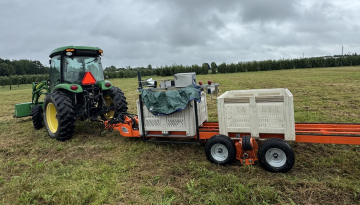
Ficio, a startup founded by Youhanna Meleka, M.Eng. ’26, is developing an AI platform for the food supply chain that can run on different machines and tackle very different jobs – from sorting apples in an orchard to turning potatoes into french fries.
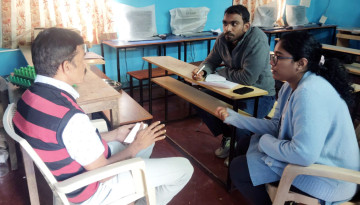
Overworked teachers in southern India have a new tool, developed by Cornell researchers, for educating their students: Shiksha Copilot, an AI system that generates culturally relevant lesson plans for schools with few resources.
As mathematicians work through challenges related to AI, Cornell math faculty members are leading the field with work integrating AI into math and mathematics into AI.