Makora, a startup founded by assistant professor Mohamed Abdelfattah, has received a $1.75 million award from the National Science Foundation-supported STRIDE Ventures AI Efficiency Challenge.
The work is paving the way for hybrid optical-electronic systems that could reduce the energy and computational resources required for AI-driven image analysis and other visual inference tasks.
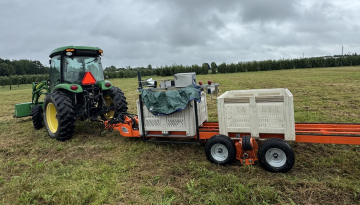
Ficio, a startup founded by Youhanna Meleka, M.Eng. ’26, is developing an AI platform for the food supply chain that can run on different machines and tackle very different jobs – from sorting apples in an orchard to turning potatoes into french fries.
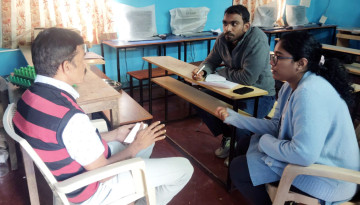
Overworked teachers in southern India have a new tool, developed by Cornell researchers, for educating their students: Shiksha Copilot, an AI system that generates culturally relevant lesson plans for schools with few resources.
As mathematicians work through challenges related to AI, Cornell math faculty members are leading the field with work integrating AI into math and mathematics into AI.
Cornell is expanding its expertise in artificial intelligence and data science thanks to the arrival of new faculty, with support from the Radical Collaboration initiative, building a research community that reaches across disciplines.
Cornell researchers’ analysis of 1.5 million petitions on Change.org showed that AI writing assistance altered the wording of petitions, increasing their homogeneity and length, but did not improve petition outcomes.
New research has found that although food companies recognized clear benefits to pooling confidential food safety, concerns about trust, competition and shared standards continue to stand in the way.
After a year of engaging with university stakeholders and at a critical moment for higher education in the United States, a faculty-led committee has offered its vision for fortifying Cornell’s long-term future in the face of unprecedented challenges.