Alexander Colvin, Ph.D. ’99, will serve on a blue-ribbon commission charged with developing recommendations on how New York state can protect workers’ economic security while harnessing the economic benefits of AI.
The panelists considered three key issues facing colleges and universities: rapidly advancing technology; an altered relationship with the federal government; and an erosion of public trust in higher education.
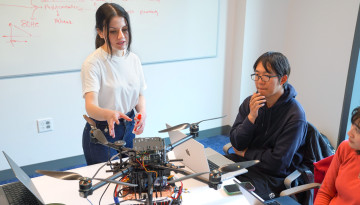
Artificial intelligence may one day give robots social intelligence, but so far, existing models do a poor job of using human facial cues to predict the outcome of a situation.
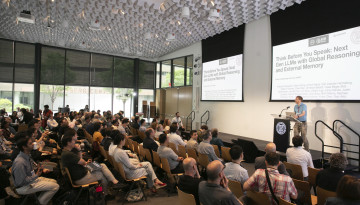
The 2026 Econometric Society Interdisciplinary Frontier: Economics and AI+Machine Learning Meeting will feature keynote talks, a panel discussion, and presentations from some of the sharpest minds in economics and AI.
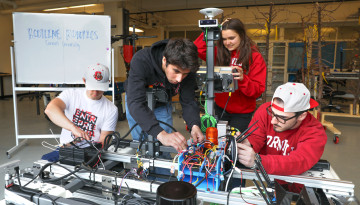
Cornell researchers have developed a computing device that stores information electrically but reads it through tiny mechanical motion, an approach that could open a path toward more energy-efficient hardware for AI and scientific computing.