Two new initiatives involving artificial intelligence in Cornell classrooms will encourage experimental and balanced use, while exploring ways to deploy AI that align with the teaching needs and strategies of individual academic fields.
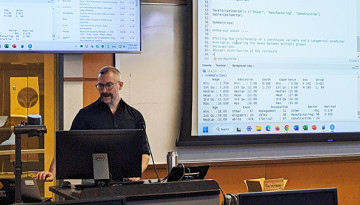
CSCU will host “Ask the Statisticians: AI in Scientific Research,” a free virtual session to discuss how Cornell researchers are integrating AI into their statistical workflows.
An innovative major in the College of Arts & Sciences is being expanded and refined to highlight its combination of science, social science and the humanities and its relevance to careers today.
A $1.49 million award from the John Templeton Foundation will enable Cornell researchers Gordon Pennycook and David Rand ’04 to explore whether artificial intelligence can be used to understand and increase open-mindedness.
New event asks the community to decrease technology use, increase face-to-face interaction and consider that every AI chat, doomscroll and text message has a water, energy and carbon footprint.
Cornell and global leaders will come together at Climate Week NYC Sept. 20-27 to discuss some of the world’s most pressing sustainability challenges, including harnessing AI’s power while mitigating its negative impacts.
Cornell researchers have used artificial intelligence to uncover a previously unknown way cells control how proteins move inside them, a process essential for growth, communication and movement, and one that is often disrupted in cancer.