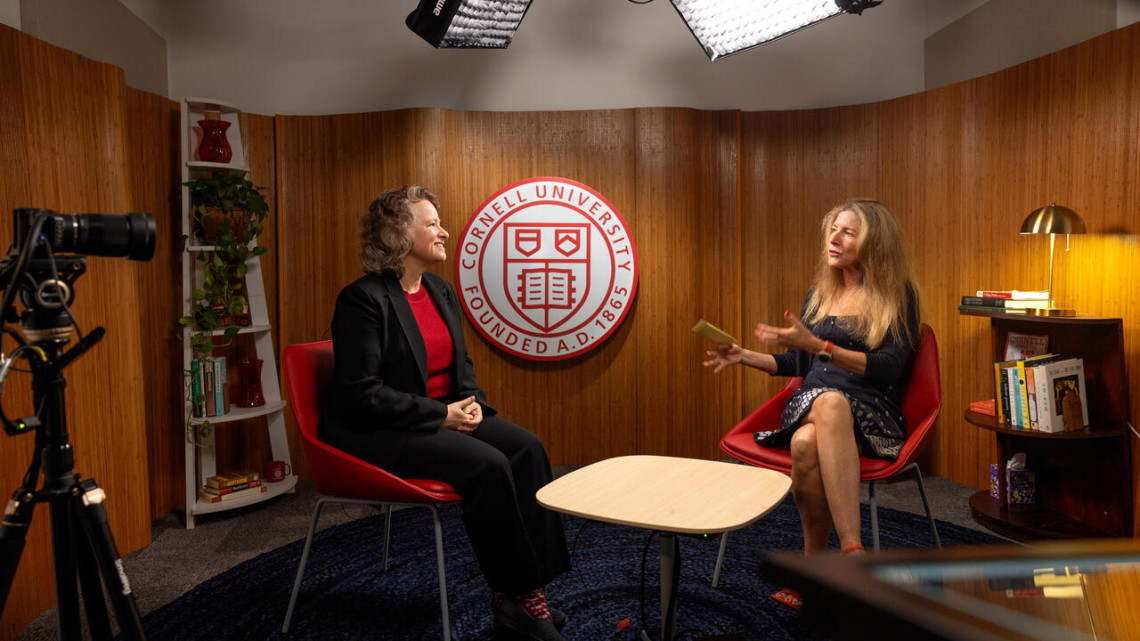
Cornell behavioral economist Suzanne Shu, left, and Cornell Chronicle writer Laura Reiley discuss "Why Don't We Do the Things We Know We Should?" in the first episode of season two of the Research Matters video podcast series.
Research Matters returns, following ideas from the lab to real life
Last spring, Research Matters set out to show how Cornell scholarship routinely bursts out of the lab and library. Now the video podcast series, back for a second season, ranges even further, from an emergency room to a courtroom, from a basketball court out to the universe itself.
The 18-episode season launches with “Why Don’t We Do the Things We Know We Should?” In it, Cornell behavioral economist Suzanne Shu – an electrical engineer turned behavioral economist – breaks down the psychology behind procrastination, overspending and our strange attachment to stuff in order to illustrate why willpower isn’t the problem, and what actually helps.
“Cornell researchers devote their careers to solving the world's hardest problems,” said Monica Yant Kinney, associate vice president for communications in University Relations. “Research Matters pulls back the curtain so everyone else can see what that work actually looks like. Whether it’s why we procrastinate, how tipping got so confusing or what's really driving up health insurance costs, this is where big research turns into everyday, useful knowledge.”
Season Two builds on the first season, widening the lens even further. Robotics researcher Angelique Taylor of Cornell Tech’s AIRLab joins to talk about what happens when a robot enters the chaos of a hospital emergency department. Cosmologist Michael Niemack traces the technology used to listen for the universe’s oldest light, and electron microscopist David Muller explains how a machine that resolves single atoms is reshaping what materials scientists thought was possible.
Other episodes trace money, power and belonging. Hospitality scholar Michael Lynn breaks down the strange economics of tipping, an American habit few can explain and fewer can escape. Economist Eswar Prasad takes on global economic instability and what it means for ordinary savers, while health economist Colleen Carey untangles the sometimes-absurd design choices baked into the health insurance market.
New ideas for combating climate change and improving the health of our planet are part of this season, as well. Biogeochemist Benjamin Z. Houlton, dean of the College of Agriculture and Life Sciences, makes the case for soil and trees as climate infrastructure, and architect Felix Heisel shows how buildings can be designed for a second life instead of a landfill.
The season also digs into questions of care and belonging. An eldercare-focused conversation with Jenna Wells and Adriana Reyes examines who is designated to care for a rapidly aging population. Political scientist Rachel Beatty Riedl looks at the warning signs of democratic backsliding, while her colleague Suzanne Mettler traces the widening political divide between rural and urban America.
Season One built its audience by finding the everyday stakes inside academic work: Psychologist Jessica Salerno explored how a caller's tone can shape whether police treat a 911 call as a victim’s plea or a suspect's confession. Biomedical scientist Glenn E. Simmons Jr. traced how fat and inflammation fuel cancer, and why some communities see worse outcomes than others.
The series went deep on artificial intelligence and our digital world: Computing and business scholar David Rand examined how AI sways what we think, and even how we vote. Misinformation researcher Claire Wardle spent the episode describing what she calls “the armpit of the internet,” explaining why people trust a stranger’s post over an expert’s data. And psychologist Gordon Pennycook explored the surprisingly relatable science of why smart people believe dumb things, from conspiracy theories to convincing-sounding nonsense.
Veterinarian Elisha Frye walked through how Cornell’s Animal Health Diagnostic Center catches diseases before they jump from animals to people. And engineer Robert Shepherd previewed a future of robots built not from bolts and steel, but from living tissue, fungal networks and soft, 3D-printed materials.
“If you’ve ever wondered how academic research connects to the choices you make, the systems you rely on or the future you're inheriting, take a listen,” said Laura Reiley, the show’s host. “Season One showed people will watch a researcher think out loud, as long as you get out of their way.”
New episodes of Research Matters will post every Tuesday at noon through the semester on the Cornell Chronicle website and everywhere podcasts are found, including Spotify and Apple Podcasts, with video on YouTube and clips on LinkedIn and Instagram.
The Research Matters video podcast is produced by University Relations, with contributions from broadcast specialist Garth Avery; multimedia producers Alex Bayer, Devin Flores, Sreang Hok, Jason Koski and Ryan Young; writer and editorial coordinator Holly Hartigan; social media specialist Gray Hughes; strategic communications specialist Genna Knight; digital designer Shea Oleksa; and writer Laura Reiley.
Media Contact
Get Cornell news delivered right to your inbox.
Subscribe