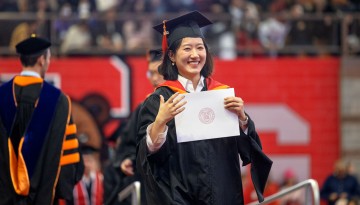
On Dec. 18 in Barton Hall, more than 700 recipients of bachelor’s, master’s and doctoral degrees were honored at the university’s 20th recognition ceremony for December graduates, held in-person for the first time since 2019.
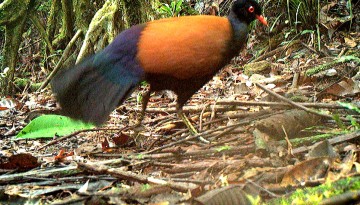
The first recorded proof of a bird not seen for 140 years, a gut bacteria that could regulate cholesterol and a senior who risked his own life to rescue a man from an oncoming subway train were among the most-read Cornell Chronicle stories of 2022.
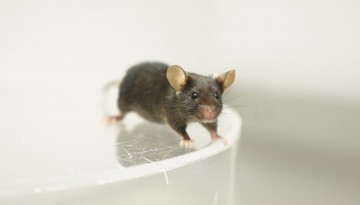
Cornell researchers found a link between the rate of ultrasonic vocalizations in mouse pups and their activity levels, which is important for understanding mouse models of communication disorders, including autism spectrum disorder.
A Cornell-based database of “runaway ads” placed by enslavers in 18th- and 19th-century U.S. newspapers was the starting point for a new song cycle entitled “Songs in Flight” that will premiere Jan. 12 at the Metropolitan Museum of Art in New York City.
Paul R. Hyams, professor emeritus of history in the College of Arts and Sciences and a leading scholar of the history and practice of law in the Middle Ages, died Dec. 4 of lymphoma in Oxford, England. He was 82.
Due to faster decomposition, disposable and plasticized biodegradable medical gowns introduce greenhouse gas discharge problems in landfills, according to new Cornell engineering research.
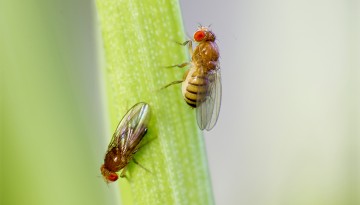
Researchers pinpointed the neuromuscular components that enable a fruit fly to stabilize its pitch, providing evidence for an organizational principle in which each muscle has a specific function in flight control.
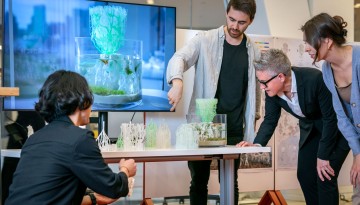
Cornell has established the Department of Design Tech, a Radical Collaboration partnership between five colleges that seeks to enhance design and technology education and research across the university.
Cornell students have until January 3 to enroll in Winter Session's newest offering: Introduction to World Poetry. The online course is led by Alan Scott Weber, a professor of English who teaches humanities at Weill Cornell Medicine-Qatar. Winter Session Online runs January 3 –20. 2023.