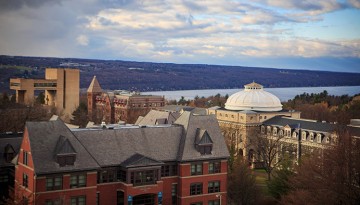
Two grants, from the National Endowment for the Humanities and the Mellon Foundation, are supporting a web of collaborative, public-facing humanities projects initiated by Tao Leigh Goffe, assistant professor of Africana studies and feminist, gender and sexuality studies in the College of Arts and Sciences.
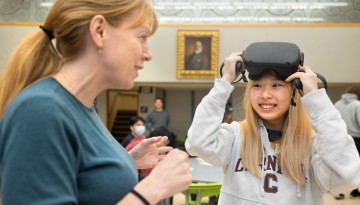
Thanks to Cornell’s Center for Teaching Innovation, students recently had the chance to prepare a sample for cryo-electron microscopy – a technique not often available to young researchers – using virtual reality headsets.
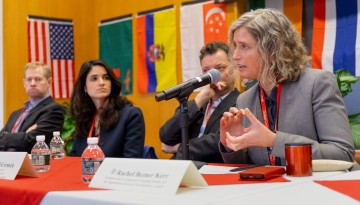
More than 300 faculty, staff and students from Cornell and the new Cornell Global Hubs gathered Nov. 16-17 to discuss ideas for the next universitywide Global Grand Challenge.
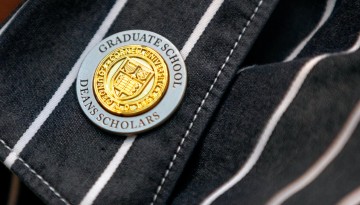
The Graduate school welcomed over 80 new Dean’s Scholars into the community of over 370 current Dean’s Scholars at Cornell. The Dean’s Scholars program honors recipients of competitive, diversity-focused fellowships.
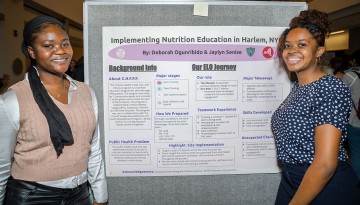
More than 100 students presented their work on a wide array of projects aimed at improving access to public health everywhere from Tompkins County to Tanzania, as part of the 2022 Global and Public Health Experiential Learning Symposium, held Nov. 11 in Cornell’s Physical Sciences Building.
The founder used prose and poetry to name, document, and celebrate the New York Puerto Rican experience and its alignment with the sociocultural and political movements of the late 1960s and 1970s.
Three startups – two helping to make a green economy and one creating next-generation microbial images – graduated Nov. 16 from Cornell’s Center for Life Science Ventures business incubator.
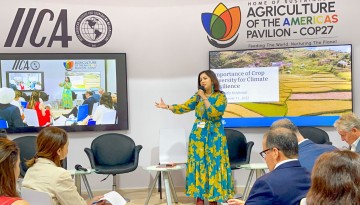
Kehkashan Basu, an MBA student at the Johnson School, hopes to kindle positive global change. She moderated the first roundtable meeting between government officials and youth at COP27.