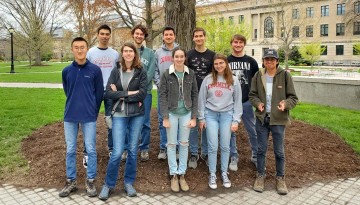
Sixteen faculty and professional staff members in Cornell’s four state contract colleges have been selected for the 2021-22 State University of New York Chancellor’s Awards for Excellence.
The Bovay Civil Infrastructure Laboratory Complex has a new tenant: a roughly 6,000-pound industrial robot capable of 3D printing large-scale structures that could make construction more sustainable.
An international team of more than 300 scientists has created the first image of the supermassive black hole at the center of our Milky Way Galaxy. Cornell contributors included Shami Chatterjee and James Cordes from the Department of Astronomy.
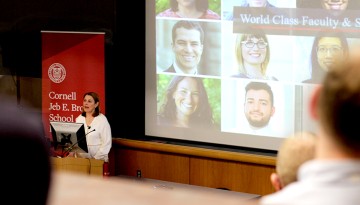
The Cornell Jeb E. Brooks School of Public Policy is about to conclude its first academic year. In a State of the School address to faculty and staff, Dean Colleen Barry outlined accomplishments from that year and new initiatives the school is about to launch. She also described the school's long-term goals including the goal of becoming one of the nation's pre-eminent public policy schools.
Funded projects this cycle reflect the Migrations initiative’s interdisciplinary priorities of racism, dispossession and migration in the United States and international, multispecies migration.
The College of Arts and Sciences awarded $1.25 million in grants to faculty members pursuing critical developments in areas ranging from quantum materials to sustainable technologies.
Tumors can force neighboring cells into supporting cancer growth by releasing lactate into their local environment, according to researchers at Weill Cornell Medicine. The findings pave the way for future drug treatments that thwart that defense mechanism to help cancer patients.
On May 13, a panel of Ukrainian experts will converge at Cornell for a hybrid event to discuss the civil and economic upheaval in their country. The event “Ukraine: War, Economy, Path to Rebuilding” features a panel of Ukrainian government officials, academics and business experts with insights into the state of the economy and postwar plans.
A Cornell study found that still images of models in online retail ads had statistically lighter skin tones than those in videos of the same product and model. They also found evidence of “tokenism” – one model who was considerably darker-skinned than the others.