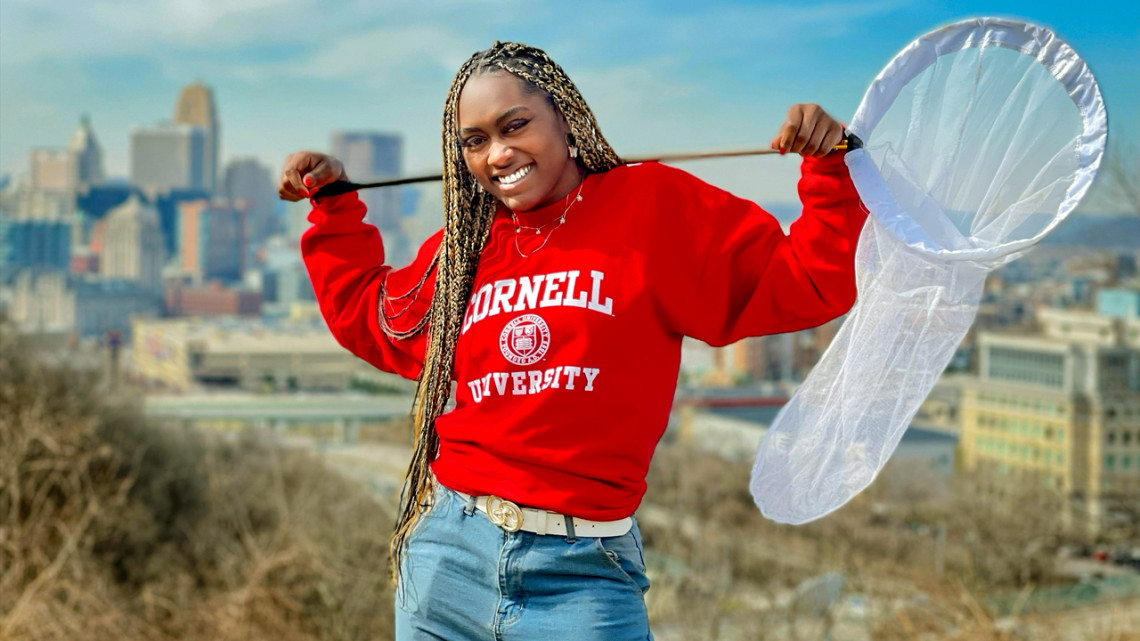
Doctoral student Sylvana Ross spent the summer leading the Cincinnati Urban Ecology Study to better understand the insects in the city’s green spaces.
The secret lives of city insects: bringing urban ecology to the community
By Holly Hartigan, Cornell Chronicle
In manicured city parks and scrubby parking lot borders, insects reveal their secrets to doctoral student Sylvana Ross and a team of Cincinnati youths.
This summer, she and her partners studied city-dwelling insects, amassing data that can inform decisions that support healthy green spaces and help connect young people to the nature outside their front doors.
“We need pollinators for the community gardens that are feeding our communities,” Ross said. “We need insects to help monitor the ecosystem function. We can use insects to identify pollution burdens and air quality and soil quality, and those all play a role in human health.”

Ross captures ants found in a green space in Syracuse as part of a pilot study on ant foraging preferences.
Urban ecology is a relatively new field, according to Ross’ adviser Corrie Moreau, the Martha N. and John C. Moser Professor of Arthropod Biosystematics and Biodiversity in the College of Agriculture and Life Sciences. Most ecologists have focused on comparing urban spaces to natural spaces. Ross’ research, which has received funding from the Cornell Atkinson Center for Sustainability, is one of the first to look at how historical structuring of cities affects biodiversity.
“It’s really allowing for a better understanding of what aspects of green spaces make them more robust, thriving ecological communities,” Moreau said. “All the literature out there tells us that the more robust and diverse a community is, the more resilient it is to variation and disruption, like from climate change.”
Ross studied biology at the University of Cincinnati, graduating in 2018 and staying in the city after graduation to work for a company that taught health in public schools.
She grew to love Cincinnati and feel connected to the people there. “I always say I was raised in Colorado, but I grew up in Cincinnati,” Ross said.

Adult damselflies found at Lick Run Greenway in Cincinnati are indicators of stream health because they start their lives underwater before emerging as adults to feed on smaller insects.
As a teacher, she saw a demand for science education but few resources to really teach it. However, she realized she could take the students outside to look for bugs.
“There were so many bugs,” Ross said. “There’s clover growing in their lawns. There’s plantain, and there’s hoverflies and bees and wasps and butterflies flying around. That helped me bring environmental science to those students without having to bus them to a nature center.”
Ross became as fascinated with insects as her students did. She noticed that she saw more insect diversity in littered lots than in well-manicured parks. She wondered why and whether other unexpected discoveries were hiding in urban spaces.
When the pandemic hit and she lost her teaching job, she thought she could try to answer her questions in graduate school.
Human history and hot city ants
First, Ross worked in Baltimore and Philadelphia, studying ants across several neighborhoods. She found that ants in some regions of the city showed a higher tolerance to heat.
She created maps of ant types and then overlaid them with redlining maps, which dictated who was eligible for federal housing loans in the 1930s. She found that neighborhoods with primarily Black residents during that period are currently hotter, with less tree cover and higher pollution burdens.
“The lack of financial equity from historical segregation impacts the environment that we see today,” she said.
Cincinnati Urban Ecology Study
Ross said she “parachuted” into Baltimore and Philadelphia, but she knew she could really make a difference in Cincinnati, with her background in teaching and deep ties to the community.
She partnered with Queen City Pollinator Project (QCPP), an organization she had worked with in 2020, installing beehives on rooftops, to form the Cincinnati Urban Ecology Study (CUES).
With the help of QCCP co-founder Jenny O’Donnell, Ross enlisted a group of 15 teens and young adults to classify pollinator diversity and collect ant foraging data in seven green spaces across three types of neighborhoods.
Not only did the students collect data, they’re interpreting it, too. This fall, they’ll help present it to the entities that oversee the green spaces they studied.

Cincinnati Urban Ecology Study community research scientists collect data on ant foraging behavior at Burnet Woods in Cincinnati.
“If they notice that there are certain pollinator groups, specifically some native bee species, that might be more prevalent at one site than another, they can advocate for more resources to boost the native pollinator biodiversity,” Ross said, “like planting more native plants, having more access to undisturbed soil for some of our ground nesting bees, or having more community or volunteer driven work to remove invasive species to allow for more native species to survive in those areas.”
The data the group collected this summer presents a clearer picture of a green space’s value, O’Donnell said.
“Maybe the tree canopy is amazing or there’s a bird species,” she said. “CUES is trying to be the eyes and ears of the naturalists of the community in these urban spaces.”
Jo Ruther, a recent Ohio State University graduate, served as research assistant for CUES. The teens who participated in the field work engaged, asked great questions and made surprising observations, she said.
For instance, they were not surprised to find invasive spotted lanternflies across the city, but they were surprised to see ants, bees and wasps eating honeydew, the sticky, concentrated sugar water that the lanternflies excrete.
“This could be changing the ecology of how things are behaving,” Ruther said. “Because it is an invasive species, this is new to everyone, including our little critters.”
Ross said she wants the students who work on CUES to feel connected to nature and gain confidence to become land stewards of their local ecosystems.
“Sylvana’s enthusiasm and excitement for her work are just infectious,” Moreau said. “It makes you want to participate, which is why I think she’s been so successful connecting with communities and with nonprofit organizations and legislators that might want to understand how our work is important.”
Media Contact
Get Cornell news delivered right to your inbox.
Subscribe