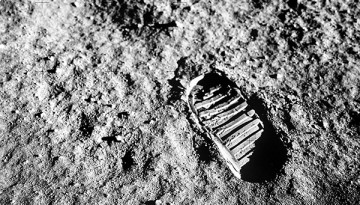
Cornell will celebrate the 50th anniversary of the Apollo 11 moon landing with a panel on exoplanetary discovery, a lecture by author Andrew Chaikin, music by the Aeolus Quartet and a display in Kroch Library.
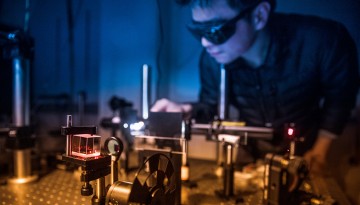
A breakthrough imaging technique developed by Cornell researchers shows promise in decontaminating water by yielding surprising and important information about catalyst particles that can’t be obtained any other way.
The White House has recognized Cornell faculty members – Thomas Hartman, Jenny Kao-Kniffin, Kin Fai Mak and Rebecca Slayton – with Presidential Early Career Awards for Scientists and Engineers.
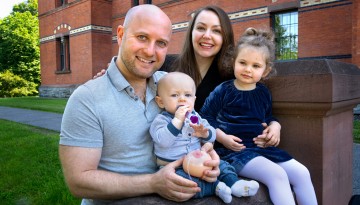
Max Spivak ’07, MBA ’14, MILR ’15, and his wife Kate Spivak have launched a company, Laally, to manufacture and sell Kate’s invention, a breastfeeding supplementation device called the Bridge.
Cornell has been chosen to host the 51 Pegasi b Postdoctoral Fellowship in Planetary Astronomy, which provides up to eight postdoctoral scientists per year up to $375,000 of support over three years.
The Society for Behavioral Neuroendocrinology recently honored professor emerita Elizabeth Adkins-Regan with its Daniel S. Lehrman Lifetime Achievement Award.
Song Lin, assistant professor of chemistry and chemical biology, has been selected to receive an Office of Naval Research Young Investigator Award, which supports early-career research.