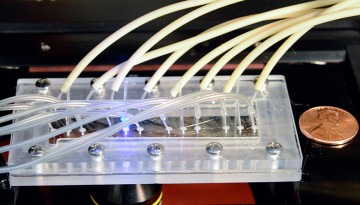
A Cornell-led team took an interdisciplinary approach to analyzing the behavior of breast tumor cells by employing a statistical modeling technique more commonly used in physics and economics.
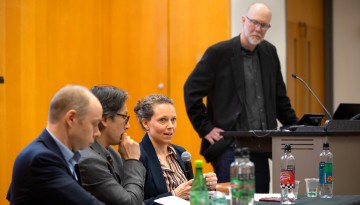
On topics ranging from oceanic disease to restraining invasive species from distant seas, Cornell faculty joined 10,000 scientists to discuss “Envisioning Tomorrow’s Earth” at the AAAS meeting in Seattle.
Yusef Salaam, one of the five teenagers wrongly convicted in the Central Park jogger case in 1990, gave the Martin Luther King, Jr. Commemorative Lecture Feb. 17 in Sage Chapel.
Sergio Garcia-Rios, assistant professor of government and Latina/o studies, is leading Univision’s polling of Latino voters through the 2020 election cycle.
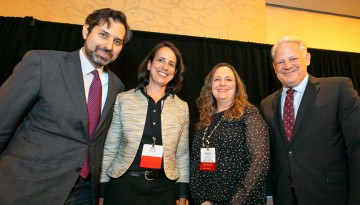
Is the American dream alive? Steve Israel, director of Cornell’s Institute of Politics and Global affairs, shared his thoughts on the subject as part of a panel discussion during the recent “State of the American Dream” event in New York City.
Quiet rooms and friendly nurses sway hospitals' patient satisfaction scores more than medical quality or survival rates, according a new study by Cristobal Young, associate professor of sociology.
Events at Cornell include the Martin Luther King, Jr. Commemorative Lecture with Yusef Salaam; pianist Philip Carli and silent films at Cornell Cinema; astrophysicist David Stevenson, Ph.D. '76; and the 2020 Backyard Bird Count.
The iconic “pale blue dot” photograph of Earth was taken 30 years ago – Feb. 14, 1990, at a distance of 3.7 billion miles – by the NASA spacecraft Voyager 1 as it zipped toward the far edge of the solar system.