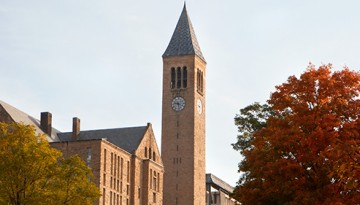
Faculty and students from Cornell departments teaching design studios and design thinking will exchange ideas to foster connections between fields and strengthen pedagogy at the inaugural Design@Cornell Roundtable Feb. 14.
Professor of practice Jon McKenzie is helping area students see the possibilities in making media, from info comics to video, to tell stories about real issues in their lives and in their communities.
Seventy-five years after the liberation of the Auschwitz concentration camp, close to 200 people gathered in Ithaca to explore the continuing question of the role moral courage plays in confronting hate.
As the impeachment trial of President Donald Trump unfolds in the U.S. Senate, two Cornell professors offered their perspectives on the event and what it says about the current state of American politics.
Maria Cristina Garcia, from the College of Arts and Sciences, and Anthony Burrow, from the College of Human Ecology, have won the inaugural Faculty Award for Excellence in Research, Teaching and Service Through Diversity.
The Spitzer Space Telescope – with its Cornell-developed infrared spectrograph instrument – has been peering through murky cosmic dust to study the distant heavens. The mission ends Jan. 30.
Undergraduates can now apply for the new Science Communication and Public Engagement minor, designed to prepare students to be socially engaged scientists who can clearly communicate their findings.
Cornell and Rice University researchers have found that while adding carbon organic matter to fields is advantageous, it may muddle the beneficial underground communication between legume plants and microorganisms.
An all-expenses-paid four-week course for rising Cornell sophomores aims to increase the number of underrepresented minorities majoring in computer science.