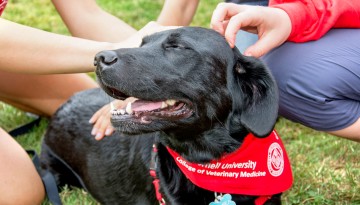
A $30 million gift from Margaret and Richard Riney has endowed and named the Cornell Margaret and Richard Riney Canine Health Center at the College of Veterinary Medicine to improve the health and well-being of dogs.
The Laidlaw scholars at Cornell are diving into a world of research. Over the first summer of the program, 24 Cornellians selected for the prestigious international program completed research projects on topics ranging from migration and big data to entomology, engineering communications and animal science.
Weill Cornell Medicine has received a $1.27 million grant from the United States Department of Defense to develop treatment for a rare but devastating eye condition largely affecting military personnel who suffer traumatic eye injuries in combat.
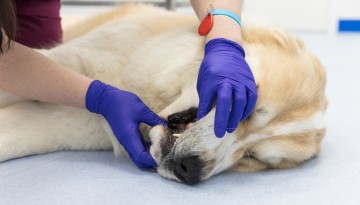
Recent Cornell research compared the profiles of a nonlethal canine tumor and the rare, devastating human oral tumor it resembles, laying the groundwork for potential translational medicine down the road.
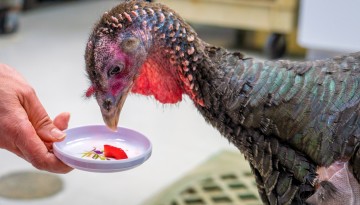
While Thanksgiving may be a perilous time for turkeys, one wild turkey has a lot to be grateful for as she recovers at Cornell’s Janet L. Swanson Wildlife Hospital from a dog attack.
The Cornell Center for Social Sciences grant program, which supports social science research by Cornell faculty members and conferences that directly benefit Cornell faculty and students, has awarded $145,136 for 15 proposals for fall 2021.
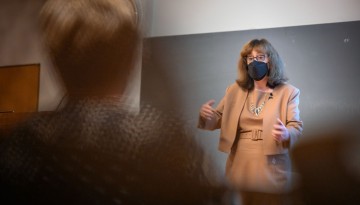
The university has done much more than just stay open, President Martha E. Pollack said Nov. 12 during her fifth annual address to staff, hosted by the Employee Assembly. Pollack offered special thanks to the Cornell University Police Department for its responses to recent events on campus.
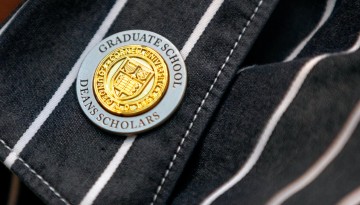
The Graduate School welcomed over 80 new Dean’s Scholars into the community of over 300 current Dean’s Scholars at Cornell. The Dean’s Scholars program honors recipients of competitive diversity-focused fellowships.
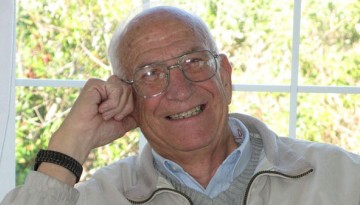
At Cornell, Robert Kahrs ’52, D.V.M. ’54, M.S. ’63, Ph.D. ’65, served as associate dean and director of veterinary admissions, and was dean of the University of Missouri College of Veterinary Medicine from 1982-1992.