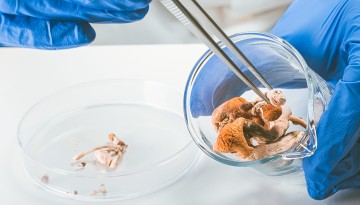
The psychedelic drugs LSD and psilocybin activate serotonin receptors on brain cells in a way that reduces the energy needed for the brain to switch between different activity states, according to a study led by Weill Cornell Medicine researchers.
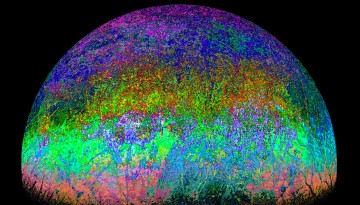
For Cornell scientists, new images from NASA’s Juno spacecraft flyby Sept. 29 of Jupiter’s moon Europa – an icy, oceanic world that may host life – brings future mission into frigid focus.
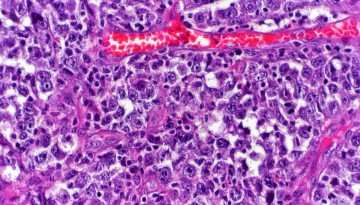
The presence of some fungal species in tumors predicts – and may even help drive – worse cancer outcomes, according to a study from Weill Cornell Medicine and Duke University researchers.
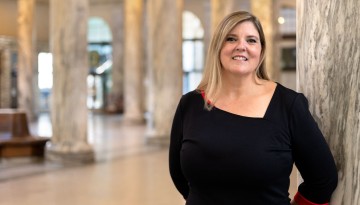
The 10th recipient of the Hometown Alumni Award, Caroline Williams '01 has spent the last 15 years working to improve living conditions in Utica, New York, and her nearby hometown of Remsen.
Xiaolong Liu, a postdoctoral researcher in physics, and Wen Zhang, a postdoctoral researcher in chemistry, both in the College of Arts and Sciences, have received 2022 Blavatnik Regional Awards for Young Scientists.
A series of special events, including visits from alumni involved in theatre, film and television, is being planned to celebrate the 30th anniversary of Teatrotaller, a theatre troupe formed to promote Spanish, Latin American and Latino culture.
A new Cornell research project aims to gain a better understanding of how populations of microbes interact on surface environments, such as human skin, where their dynamics are not fully understood.
Two Cornell graduates, CEOs of Praxis clients REEgen and Soctera, benefit from the vibrant innovation ecosystem at Cornell and Activate’s immersive fellowship program for science entrepreneurs.
A delegation of more than 50 faculty, students and staff from Cornell Bowers CIS attended the Richard Tapia Celebration of Diversity in Computing conference in D.C.
As doctoral students nearly 20 years ago, two Cornell researchers played an early role in the development of the work that was awarded the 2022 Nobel Prize in chemistry.