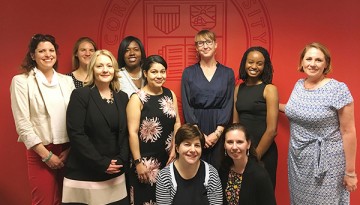
Nutrition educators from across New York state joined Cooperative Extension staff and university faculty June 17-18 for a celebration of the 50th anniversary of the Expanded Food and Nutrition Education Program.
The Cornell Dairy Foods Extension certificate program run by the Department of Food Science in CALS helps industry people learn the ins and outs of product safety and quality.
Cornell University and the Core Foundation have signed a five-year Memorandum of Agreement to explore new ways to promote food security and agricultural innovation in Latin America.
Published research by chemist Nozomi Ando, performed at CHESS, has identified a new vulnerability in bacteria that offers a possible avenue for dealing with antibiotic resistance.
To address a funding imbalance, the Cornell Women’s Grant Fellows Workshop aims to familiarize female assistant professors with the landscape of federal funders, program officers and grant applications, and to teach tips for writing a winning proposal.
Four new faculty projects have been selected to receive funding for collaborative, cross-disciplinary opportunities for learning and research in New York City.
Cornell plant breeders and geneticists, who’ve played a significant role in the improvement of the potato, are expanding their efforts as they make more wild potato seeds available to breeders around the world.
Eighteen Cornell doctoral students from 13 fields of study have received 2019-20 Engaged Graduate Student Grants to support community-engaged research relevant to their dissertations.