Organizations can persuade people to pay attention to society’s problems by making emotional appeals, with eye-catching statistics and human interest stories, according to a new study co-written by Adam Seth Levine.
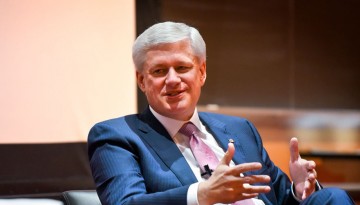
In a world teeming with trade and immigration controversy, Stephen Harper, the conservative former Canadian prime minister, urged a Cornell audience on March 7 not to ignore rising populist or nationalist campaigns.
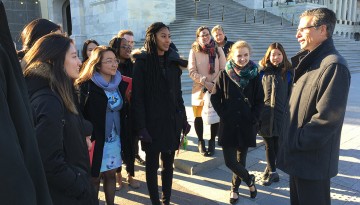
Nineteen Cornell students traveled to Washington, D.C., March 6 for the annual Student Aid Advocacy Day, where they met with congressional members and staff.
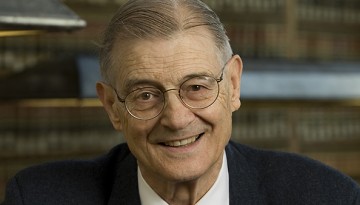
Robert S. Summers, who grew up milking cows on his family’s farm in Oregon and went on to co-write the most widely cited treatise on U.S. commercial transaction laws, died March 1. He was 85.
The ILR School held an opening ceremony Feb. 28 for its New York City hub, at the historic GE building at 570 Lexington Ave., which will be a center for ILR and nine other colleges and programs.
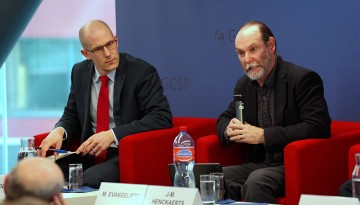
History professor Matthew Evangelista was part of a recent panel discussion at an event in Geneva, Switzerland, marking the 70th anniversary of the 1949 Geneva Conventions.
In a groundbreaking study illuminating the extensive scope of mass incarceration in the U.S., nearly 1 in 2 Americans have had a member of their immediate family spend time in jail or prison – a far higher figure than previously estimated.
Mark Whitmore, extension associate in the College of Agriculture and Life Sciences, briefed congressional staffers on an invasive species threatening hemlock trees and ways to combat it.
A pair of Cornell librarians traveled to Africa earlier this year to conduct workshops and help researchers advance food security and legal scholarship.