What do the White House, the U.S. Justice Department Civil Rights Division, the U.S. Centers for Disease Control, and the Senate Majority Leader’s office have in common? Cornell students have worked at each institution through Cornell in Washington (CIW), a semester-long engaged learning program founded in 1980 and housed at the Brooks School for Public Policy.
Enrolling in a selective college STEM program pays off more for academically marginal students – even though they are less likely to graduate, Cornell economics research finds.
At the May event, students covered topics focused on countries around the globe and ranging from immigration, home care workers and female sports culture to the U.S.-China relationship, the repatriation of cultural objects and AI and literature.
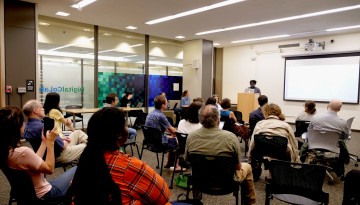
Home to Cornell University Library’s Digital Scholarship Services, the Digital CoLab on the 7th floor of Olin Library stimulates innovation in research and teaching while building connections among scholars across campus. It follows one simple formula: “People over projects.”
In its world-class research and teaching, Cornell Bowers CIS is uniquely positioned to guide tomorrow’s innovators as they dive into issues of ethics, fairness and privacy, while weighing the policy implications of technological advances.
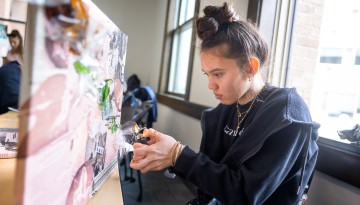
Through the capstone course Art and Science of the Mohawk River Watershed, a group of environment and sustainability majors studied the river through the lenses of art, science and culture, deepening their understanding of a complex natural system.
The Brooks School Tech Policy Institute (BTPI) has announced a $1M project to study financial freedom in countries with authoritarian governments. Led by BTPI Director Sarah Kreps, the research will employ quantitative and qualitative approaches to understanding the use of Bitcoin and stablecoins by individuals around the world.