A new study by an international research group led by scientists at Cornell's Baker Institute for Animal Health shows that genetic differences in immune function between horses account for skin tumors.
Four Cornell projects were awarded more than $1.65 million in total by the United States Department of Agriculture for research on plant health, production and resilience.
Colin Parrish, Ph.D. ’84, an expert in animal virology, will share share his knowledge and ideas as a visiting professor at the University of Glasgow, Scotland, as Fulbright scholar.
Vikram Gadagkar, MS ’10, Ph,D, ’13, was recently awarded a three-year, $234,150 Simons Foundation fellowship with the Simons Collaboration on the Global Brain.
In recent years, Cornell has amassed an impressive stable of experts in an emerging field for modern times: The ecology and evolution of infectious disease.
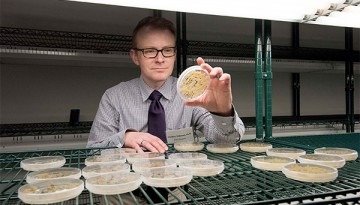
Matthew Willmann, director of the new Plant Transformation Facility, is harnessing precision technology to create transgenic and gene-edited plants on campus for Cornell researchers.
Thirty-three seniors from Cornell's seven undergraduate colleges are honored as Merrill Presidential Scholars in ceremony May 25 in Willard Straight Hall Memorial Room.
A new study of the distribution in North American soils of Streptyomyces, a genus of bacteria is the source of 80 percent of antibiotics, finds it corresponds with latitude.