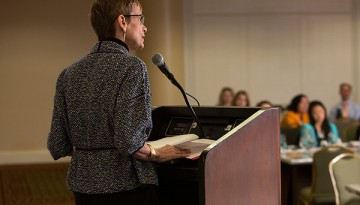
A Gates Foundaton-funded collaboration to make genomic tools for crop breeders held a workshop last week to solve their "big data" issues to make a massive genomics database for staple crops.
At the President’s Sustainable Campus Committee fall summit Nov. 12, Elizabeth Garrett underscored the university’s commitment to addressing climate change by announcing formation of the Senior Leaders Climate Action Group.
Weill Cornell Medicine has entered into an agreement with Top Spring Huaxia Medical Investment to help it develop a modern outpatient diagnostic clinic in Shenzhen, China.
New York Times national security correspondent David Sanger spoke on campus Nov. 10 about foreign policy in the Bush and Obama administrations and the future of modern warfare.
Cornell Alliance for Science Global Leadership Fellows soon will return home to 10 countries, taking with them a set of communication tools to contribute to local policy debates on ag technology and food security.
Events on campus this week include a Cornell Chamber Orchestra family concert, 'On the Verge' at the Schwartz Center, International Education Week and the Local Food and Fiber Fair at Mann Library.
Nearly 300 Cornell alumni, parents and friends welcomed President Elizabeth Garrett Nov. 10 to Washington, D.C., the first stop of her tour to meet Cornellians in cities across the country and overseas.
Researchers at the Boyce Thompson Institute are studying the bacterium speck, which causes withered flowers and dark spots on leaves and fruits, and can result in the loss of whole fields of crops.