The Ezra’s Bridge program aims to address challenges faced by populations underrepresented in chemical and materials sciences by providing students with a full-tuition scholarship, research opportunities and mentoring.
A new X-ray technique developed at Cornell offers an unprecedented look at the elaborate inner workings of batteries while they are in use – a breakthrough that is already yielding important findings for the development of next-generation energy storage.
A new artificial intelligence tool developed by Cornell researchers promises to help speed up searches for novel metastable materials with unique properties in fields such as renewable energy and microelectronics.
The COVID-19 pandemic has shown humanity a new way to reduce climate change: Nix in-person conventions. Putting meetings online can reduce carbon footprints by 94%, says a Cornell study.
Around 1,450 Cornell students completed their studies this month. While the December Recognition Ceremony was canceled, some shared their university experiences.
Peter Harriott ‘49, an emeritus professor of chemical engineering who taught for 48 years at Cornell and co-authored the defining textbook on unit operations, died Sept. 23 in Ithaca. He was 94.
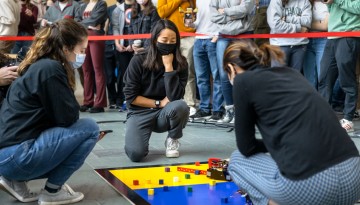
A bit of history was made in the annual robotics competition, Dec. 7 in the atrium of Duffield Hall, where a robot created by Cornell students defeated the corporate sponsor’s robot in a head-to-head block-gathering challenge.
Researchers have discovered how to “turn off” a key driver of aortic stenosis – the narrowing of the heart’s aortic valve – identifying for the first time the biological process behind certain instances of the disease.
In an oceanic omen for climate change’s intensifying effects, Cornell-led research shows that seagrass suffers from a wasting disease and root-system deterioration.