Cornell researchers have uncovered a microscopic layer of carbon contamination, often left behind by air exposure and fabrication techniques, that impairs electrical flow in devices made with gallium oxide. They also found a solution.
Using custom-built computer simulations, Cornell researchers have visualized solid-solid phase transitions in unprecedented detail, capturing the motion of every particle in a theoretical material as its crystal structure morphs into another.
A Cornell Engineering team was on the cusp of significant progress developing an advanced laser useful for military and civilian applications, but a stop-work order prevented final experiments from proceeding.
NASA and the Indian Space Research Organization are launching a satellite that uses synthetic aperture radar – and Cornell expertise – to monitor nearly all the planet’s land- and ice-covered surfaces twice every 12 days.
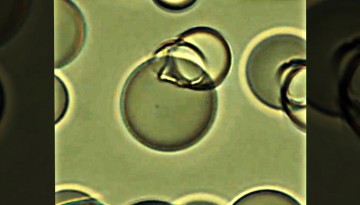
Cornell researchers have developed a two-phase liquid crystal system that can rapidly change – and hold – its shape, transforming from a transparent thin liquid film to an opaque emulsion, and then back again, all with a brief jolt of a high-frequency electric field.
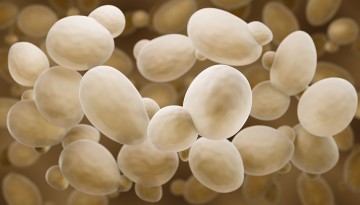
Cornell researchers have found that peaceful microbes are more likely to thrive, and their more aggressive peers perish, if their environment is harsh or experiences violent disruptions.
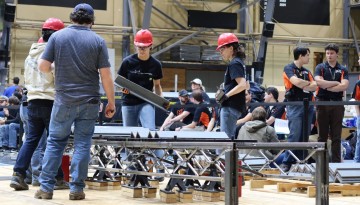
Cornell’s Steel Bridge Team excelled in the 2024 AISC competition with a 216-pound bridge that supported 2,500 pounds, placing first in lightness. Key to their success was access to the LASSP Student Machine Shop, where expert support and flexible hours enabled fast, high-quality fabrication and extra time for testing and refinement.
In a new study, researchers detail their novel approach for both detecting and controlling the motion of spins within antiferromagnets using 2D antiferromagnetic materials and tunnel junctions, which could lead to ultra-fast information transfer and communications at much higher frequencies.