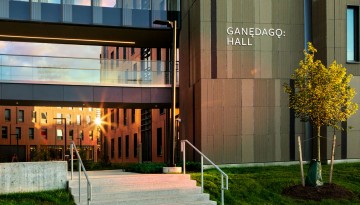
Toni Morrison Hall and Ganędagǫ: Hall – two newly opened student residential buildings – were designed and built in line with Cornell’s high standards for green infrastructure, a critical component to advancing the campus goal of carbon neutrality by 2035.
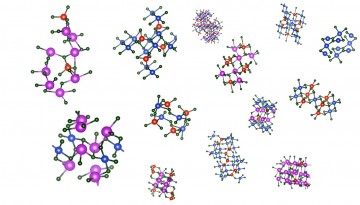
Biogeochemistry – an interdisciplinary field that examines the elemental cycles through Earth’s air, land and water – is critical to understanding climate change. Learn how it found its origin at Cornell CALS more than six decades ago.
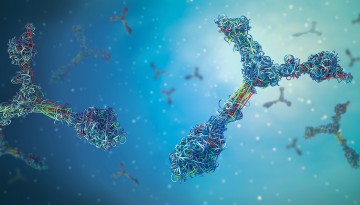
A new study published Sept. 7 in the journal of the International Union of Crystallography demonstrates that cryo-EM samples can be prepared with a safer and less expensive coolant – liquid nitrogen – and these samples can produce even sharper images than those prepared with ethane.
The collaboration will support cross-institutional scientific partnerships between students and faculty at Cornell and N.C. A&T, a historically Black university that produces more African American engineers than any other university in the United States.
An interdisciplinary research team led by Carla Gomes, professor of computing and information science, has developed Deep Reasoning Networks, which combine deep learning with an understanding of the subject’s boundaries and rules.
Researchers developed an algorithm that shows just how much more effective Spotify would be if it incorporated both likes and dislikes, in the style of platforms like Pandora.
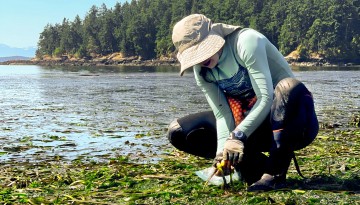
Cornell-led scientists aim to resolve a wasting disease afflicting seagrass – the ocean’s critical first line of coastal filters – with a $2.5 million National Science Foundation grant.
The new Center for Research on Programmable Plant Systems, or CROPPS, funded by a five-year, $25 million National Science Foundation grant, aims to grow a new field called digital biology.