The Cornell astronomy department will host 51 Pegasi b Fellow Samantha Trumbo, a doctoral student in planetary science at the California Institute of Technology, as she follows up on her breakthrough work on Jupiter’s moon, Europa.
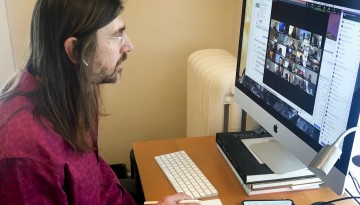
Doug McKee and his research team found that structured peer interaction helped minimize the impact of the shift to remote teaching during the COVID-19 pandemic.
New research reveals that a recently discovered songbird has traveled a very rare evolutionary path – a finding that challenges the typical model of how new species form.
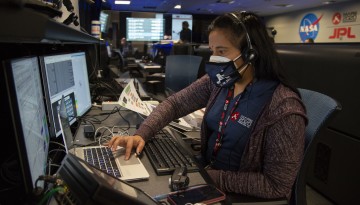
Mohan's time as an undergrad at Cornell's Sibley School was highly influential in steering her career at NASA. Now she is the guidance, navigation and controls operations lead for the Mars 2020 mission.
Cornell will honor Nobel Prize winner Barbara McClintock, renowned Chinese scholar Hu Shih and the Cayuga Nation with names for new North Campus residence hall buildings.
Neil W. Ashcroft, the Horace White Professor of Physics Emeritus in the College of Arts and Sciences and a leading theorist in condensed matter physics, died March 15 in Ithaca. He was 82.
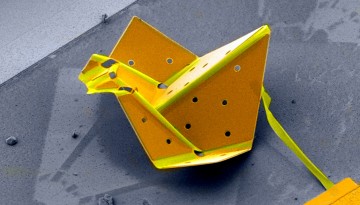
Cornell researchers have created what is potentially the world’s smallest self-folding origami bird by using micron-sized shape memory actuators to bend and hold its form.
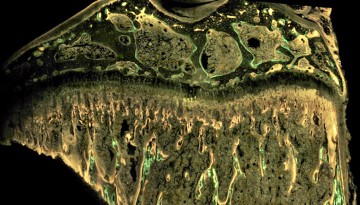
A Cornell-led collaboration has found that bones may grow in response to breast cancer tumors – possibly as a preemptive defense mechanism against metastasis. The findings could point the way to future diagnostic tests and therapeutic treatments.
Using light from the Big Bang, an international team led by Cornell and the Berkeley National Laboratory has begun to unveil the material which fuels galaxy formation.