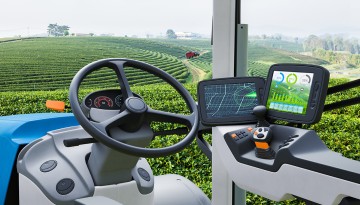
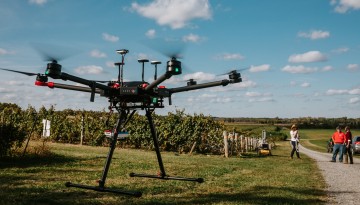
As the world seeks to avoid climate extremes, employing state-of-the art agricultural technology could result in more than 13 billion tons of net negative greenhouse gas emissions annually.
Cornell researchers unexpectedly discovered the presence of “quantum spin-glass” while conducting research designed to learn more about quantum algorithms and, relatedly, new strategies for error correction in quantum computing.
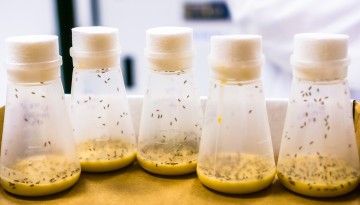
Cornell biologists report that fruit flies’ visual system, not just chemical receptors, is deeply involved in their social behaviors, which sheds light on the possible origin of differences in human social behaviors, such as those seen in people with autism.
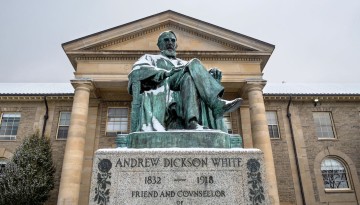
A quantum physicist and an environmental economist have been appointed the newest A.D. White Professors-at-Large, and five returning professors will visit campus this fall.
In two new papers, an international collaboration of researchers including Cornell physicists explain, on the microscopic level, why “Planckian” scattering of electrons occurs in some materials but not in others.
Jack Freed, the Frank and Robert Laughlin Professor of Physical Chemistry Emeritus, has received two grants totaling $7.8 million from the National Institutes of Health to use electron-spin resonance for the benefit of public health.
Chromium hydride, a molecule that’s relatively rare and particularly sensitive to temperature, is useful as a “thermometer for stars,” according to astronomer Laura Flagg in published research.
Students can now choose a new minor in digital agriculture, a multidisciplinary field focused on food and agriculture production systems, but with an increasingly broader span of applications and interests.
To prepare for extreme heat waves around the world, running climate-simulation models that include a new, efficient computing concept may save tens of thousands of lives.