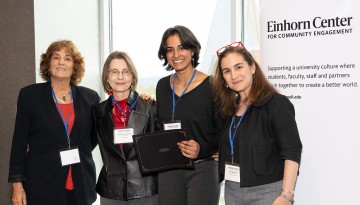
Natalia Urbas ’23 received this year’s Class of 1964 John F. Kennedy Memorial Award. She will use the $15,000 award funding to support underrepresented minorities interested in pursuing careers in research and technology.
Cornell is breaking new ground in electron beam research with the HERACLES beamline, a state-of-the-art electron gun in Newman Lab that mimics the harsh environments of the world’s largest particle colliders.
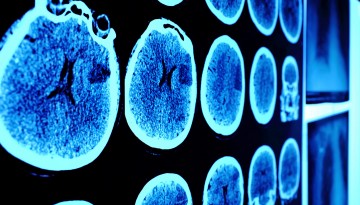
Neurons in a key area of the brain have different functions based on their exact genetic identity, and understanding this diversity could lead to better understanding of the brain’s computational flexibility and memory capacity, Cornell researchers found.
Humidity is as important as scent in attracting pollinators to a plant, new Cornell-led research finds, advancing basic biology and opening new avenues to support agriculture.
A $2.5 million grant will fund 13 research projects across the sciences, social sciences and humanities for novel investigations ranging from quantum computing to foreign policy development and from heritage forensics to effects of climate change.
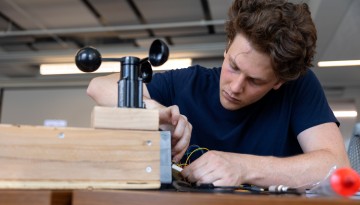
From monitoring blood pressure to potholes: Professor Max Zhang's Internet of Things (IoT) course teaches students how to leverage IoT sensor technology to solve real-world problems and help the community.
Three Cornell faculty members and a senior lecturer have been recognized with Kendall S. Carpenter Memorial Advising Awards for their sustained and distinguished contributions.
Researchers in the School of Electrical and Computer Engineering are incorporating elements of physics, circuit design, photonics, systems architecture, information theory and other fields to make quantum devices both practical and scalable.