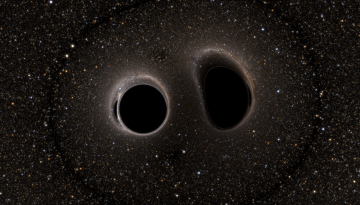
The LIGO-VIRGO-KAGRA team has announced a black hole merger similar to its first detection; a decade’s worth of technological advances allow unprecedented tests of General Relativity to be performed.
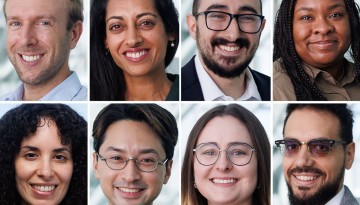
This year, 27 new faculty have joined the College of Arts & Sciences, enriching 17 departments and programs with their excellence in an impressive range of topics, including moral psychology, gravitational waves, Black contemporary art and more.
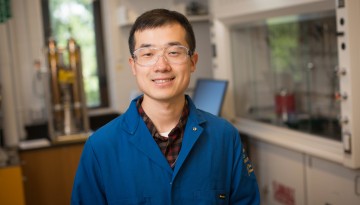
Recognized for advancing electrochemical techniques that enable efficient, sustainable synthesis of complex organic molecules, accelerating drug development, and materials innovation, Lin is a finalist in Chemical Sciences.
TRAPPIST-1 e, an Earth-sized exoplanet 40 light years away, may have an atmosphere that could support having liquid water on the planet’s surface in the form of a global ocean or icy surface.
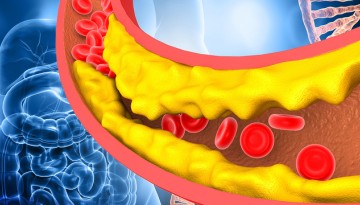
Cornell researchers have uncovered the surprising role played by a “three-tailed” fat molecule in cellular survival during heart attack and stroke: protecting the cells against damage when oxygen runs out.
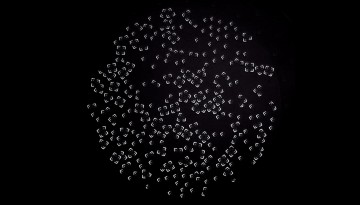
A Cornell-led collaboration developed microscale magnetic particles that can mimic the ability of biomolecules to self-assemble into complex structures, while also reducing the parasitic waste that would otherwise clog up production.
Cornell researchers have identified the signaling mechanism that triggers steroid-induced glaucoma by creating a 3D “eye-on-a-chip” platform that mimics the flow of ocular fluids.