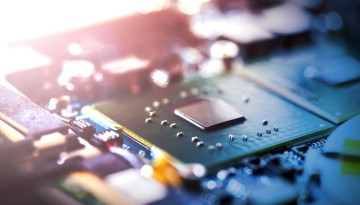
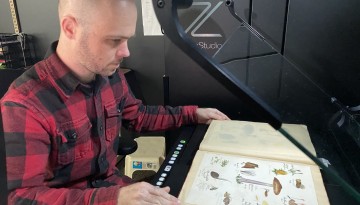
“Quantum Physics of Semiconductor Materials and Devices” authored by Professor Debdeep Jena, molds scientific subjects such as quantum mechanics, thermodynamics and electromagnetism, all under the umbrella of the semiconductor materials and devices that have become ubiquitous in daily life.
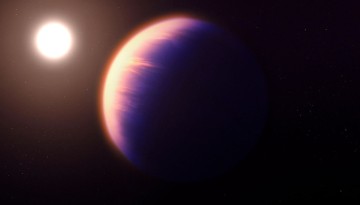
NASA’s James Webb Space Telescope opens a new chapter in scientific history, as an international team – including Cornell astronomers – found carbon dioxide evidence on the exoplanet WASP-39b.
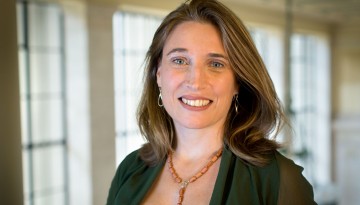
Krystyn J. Van Vliet, currently associate provost and associate vice president for research at the Massachusetts Institute of Technology, will join Cornell in 2023 as vice president for research and innovation.
Klarman Fellows pursue research in any discipline in the College, including natural sciences, social sciences, humanities and the creative arts as well as cross-disciplinary fields. The application deadline is October 14.
Researchers studying carbon removal and storage methods and novel additive manufacturing techniques are among the six Cornell faculty members who recently received National Science Foundation Faculty Early Career Development Awards.
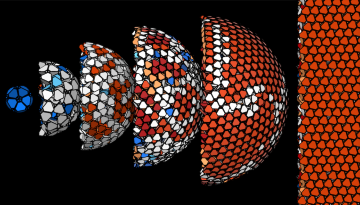
Researchers at Cornell used computer simulations to show how the assembly of a complex particle shape is affected when confined inside a spherical container. The findings offer scientists a new method for controlling the assembly structure of the resulting material.
A group of international scientists led by Cornell is evaluating how the stratosphere could be made just a little bit brighter, reflecting more sunlight so that Earth maintains its cool.
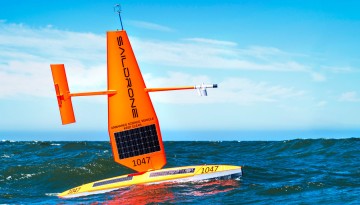
Seafaring drones soon will allow Cornell scientists to examine the abundance and distribution of forage fish – like zooplankton and shrimp – that nourish species higher on the food chain.