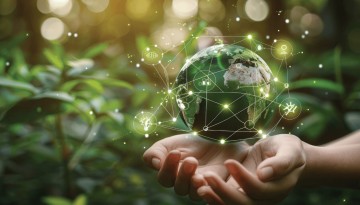
Cornell has won three of 15 major grants from the Bezos Earth Fund, awarded to leverage artificial intelligence in the fight against climate change and environmental challenges.
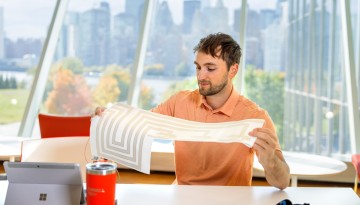
Tracking heart and lung health without wires or electrodes could be a game-changer for home care, assisted living or for patients who resist traditional wearables.
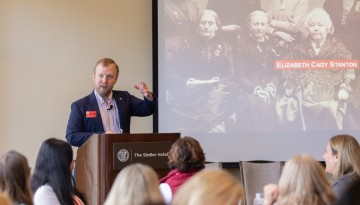
Cornell historian Corey Earle shared stories of remarkable women throughout Cornell’s history during an Oct. 25 brunch as part of the Trustee Council Annual Meeting.
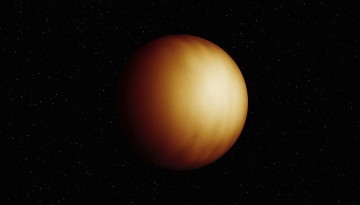
Astronomers have generated the first three-dimensional map of a planet orbiting another star, revealing an atmosphere with distinct temperature zones – one so scorching that it breaks down water vapor, a team co-led by a Cornell expert reports in new research.
Newly published digital collections at Cornell University Library explore areas of Cornell history. Freely accessible online, the three new collections were digitized from materials held in Cornell University Library’s Rare and Manuscript Collections.
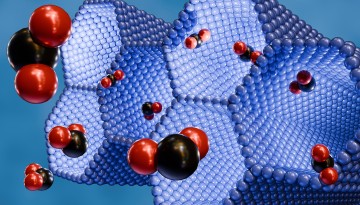
Researchers used single-molecule super-resolution reaction imaging to gain a clearer view of what happens, and where, in surface metal-hydrogen intermediates, which spark electrocatalytic transformations.
Five professors from across campus will advocate that their discipline is the most important to save for the future in the annual Apocalypse Debate, sponsored by Logos, the undergraduate philosophy journal and club.
A Cornell research group has developed a cyclodextrin-based fibrous membrane that in lab testing removed approximately 90% of aqueous triclosan, an antibacterial agent that poses a threat to aquatic organisms.