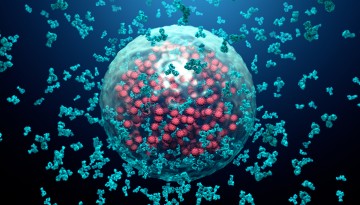
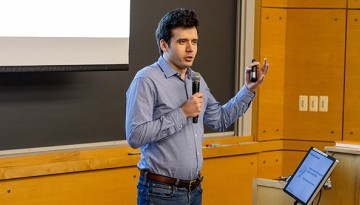
Cornell chemistry and chemical biology researchers have found a new and potentially more accurate way to see what proteins are doing inside living cells — using the cells’ own components as built-in sensors.
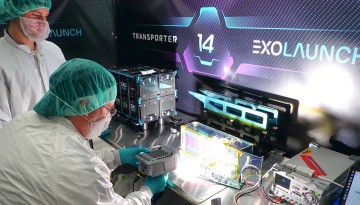
With support from Cornell’s research and testing facilities, deep-tech company AVS US – with facilities just outside Ithaca – successfully launched two spacecraft aboard a SpaceX Falcon 9 rocket on June 23
The "premier telescope in space right now" will start a fourth annual cycle of observations on July 1, and three early-career astronomy researchers in A&S are PI or co-PI on observation programs chosen from a very competitive field.
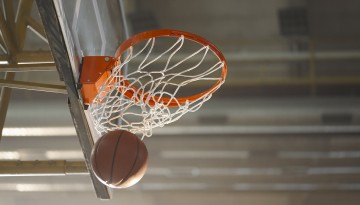
A Cornell research team has employed a variation of a theory first used to predict the collective actions of electrons in quantum mechanical systems to a much taller, human system – the National Basketball Association.
Cornell researchers have developed a soft robotic device that gently grips and injects living plant leaves with sensors that help it detect and communicate with its environment. The robot can also inject genetic material into the leaves.
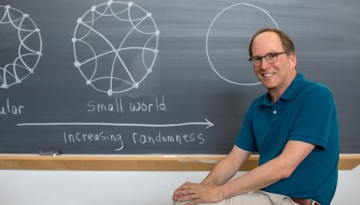
The inaugural Award for the Advancement of Science Communication as a Professional Field from the International Network on Public Communication of Science & Technology recognizes outstanding contributions to the development of science communication as a field.
Strogatz has been busy with outreach activities as the inaugural Susan and Barton Winokur Distinguished Professor for the Public Understanding of Science and Mathematics.
Gallox Semiconductors, a startup with Cornell Roots, won the 2025 Hello Tomorrow Global Challenge in the Advanced Computing & Electronics category. A member of the Praxis Center for Venture Development, Gallox is one of several semiconductor startups launched at Cornell.