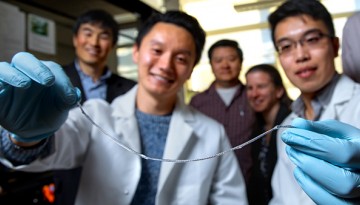
In an example of cross-campus collaboration, a group led by Minglin Ma has developed a unique implant for controlling type 1 diabetes, which affects more than 1 million Americans.
Mathematician Steve Strogatz posits an answer to an understood but unexplained medical phenomena: The incubation periods of many diseases follow a similar "lognormal" pattern.
Using multi-photon microscopy developed at Cornell, a group led by Nozomi Nishimura has shown the ability to produce detailed, 3-D images of atherosclerotic plaque.
Residents of Piermont, New York are facing climate change, as Hudson River flooding begins to encroach their waterfront streets. Cornell students provided concepts at an open house on how to handle it.
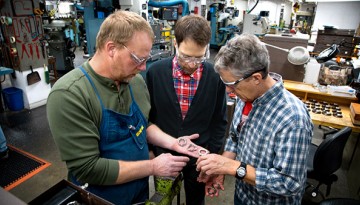
Tucked away in the basement of Clark Hall are five staff members whose machining expertise is integral to the success of many of the designs, experiments and innovations of Cornell’s physics faculty, graduate students and postdocs, as well as to work done within other departments and units across campus.
Geoffrey W. Coates, the Tisch University Professor in the Department of Chemistry and Chemical Biology, was elected to the National Academy of Inventors.
Cornell engineers have demonstrated a method for gathering vital signs using a cheap and covert system of radio-frequency signals and microchip "tags."