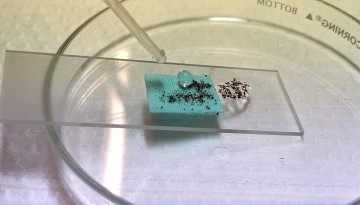
A new technique developed in the lab of Juan Hinestroza from the College of Human Ecology could create waterproof coatings for clothes out of discarded textiles – far safer for humans and the environment than current coatings.
Researchers have uncovered perplexing states in a nanomaterial as it changes its atomic structure, a discovery that could advance materials with tailored properties for renewable energy and quantum computing.
Liquefied natural gas leaves a carbon footprint that is 33% worse than coal, when processing and shipping are taken into account, according to a new Cornell study.
By fusing together a pair of contorted molecular structures, researchers created a porous crystal that can uptake lithium-ion electrolytes and transport them smoothly via one-dimensional nanochannels.
A Cornell-led collaboration has developed the first dual-sided – or “dualtronic” – semiconductor that combines photonic and electronic functions simultaneously.