Turkish director empowers students in filmmaking workshop
By Elisabeth Rosen
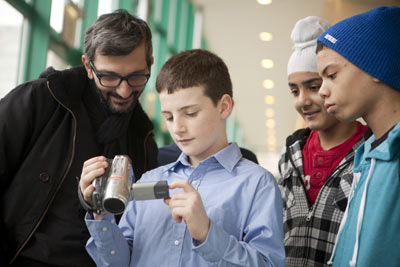
Clutching video cameras and bundled in puffy winter jackets, groups of middle and high school students -- 24 in all plus two teachers, eight students from Tompkins Cortland Community College and several Cornell students as well -- made their way across College Avenue early Saturday afternoon. Their mission was to film a 10-minute documentary -- in one hour.
Turkish-German film and theater director Neco Çelik led the three-hour workshop, "Voices Beyond Borders: Real to Reel Role-Playing," in the Schwartz Center for the Performing Arts Feb. 11 on how to create a socio-political documentary. He hoped, he said, they would use the assignment to think critically about their surroundings.
"One shouldn't go blindly through their own world," Çelik said through a translator. "This workshop is where you can learn how to ask the uncomfortable questions and become more reflective."
As students planned out their films before going outside to shoot, Çelik encouraged them to pose questions about objects and rituals they might otherwise take for granted. There was only one rule: "You have to be independent. Don't call Mommy and Daddy and ask what you're supposed to do."
By not offering the students specific instructions, Çelik hoped to give them the confidence to tackle hard questions.
"They have the cameras," said Çelik, who has been dubbed the "Spike Lee of Germany" by The New York Times. "They have the power."
The lack of specific direction also spoke to Çelik's style as a director. To make "Urban Guerillas," an internationally acclaimed coming-of-age story set on the streets of contemporary Berlin, Çelik placed amateur actors in loosely framed situations, rather than writing a script in advance. "I wanted to provide the actors with a space and let them do what they do," he said.
In Berlin, Çelik said, young people are often portrayed "in a criminal way" by the news media. The idea for these workshops arose from that reality.
"It was sort of a protest movement," he said. "If they can film something about us, then we can film something about them."
Although the aspiring filmmakers in Saturday's workshop did not face the same obstacles as the Berlin youth Çelik has worked with, they still came up with thought-provoking material. Clustered in a corner of the Black Box Theatre, one group debated two potential topics: visiting Olin Library to document how students study, or asking students across campus how they balance the independence of college life with the need to stay in touch with family. Across the room, other students were talking passionately about community issues.
"Our idea is to see how Starbucks is affecting local businesses," said Jenea Allen, a middle school student.
For professor of theater Melanie Dreyer-Lude, who helped organize the event, this kind of critical thinking was just what she had hoped for.
"The reason we're doing the workshop is to help young people develop a point of view," she explained. "Normally a guest would just give a lecture and be gone. But we thought this would be a great opportunity to give back to the community."
Çelik was on campus Feb. 9-12 to give a series of lectures and present a screening of "Urban Guerillas" Feb. 10. The workshop was also organized by Mary Bronfenbrenner, a former teacher at Ithaca High School, and Damani Partridge, associate professor of anthropology and Afro-American and African studies at the University of Michigan. Funding came from an Ithaca Public Education Initiative Community Collaboration grant.
Çelik's visit was sponsored by the Departments of Theatre, Film and Dance; Near Eastern Studies; Sociology; and Anthropology, and the Cornell Institute for European Studies.
Elisabeth Rosen '12 is a writer intern for the Cornell Chronicle.
Media Contact
Get Cornell news delivered right to your inbox.
Subscribe