Milstein Hall celebration abuzz with 500 AAP alumni
By Daniel Aloi
Nearly 500 alumni of the College of Architecture, Art and Planning (AAP) -- a record number for a college event -- mixed with faculty, staff and students March 9-11 to celebrate Milstein Hall as a showcase facility that greatly enhances the college's educational mission and reputation.
From the "bump" forming a dome on the first floor to the expansive architects' workspace in the second-floor studio, the building, which opened last August, also proved to be a social space where the college hosted a dance party, dinners, breakfasts and receptions.
"We will be celebrating with a 36-hour double-dome party the likes of which this college has never witnessed," said Kent Kleinman, the Gale and Ira Drukier Dean, who promised just such a celebration to AAP graduates in 2009, when Milstein Hall received the final go-ahead for construction following a decade of abandoned design schemes and city and university approvals. Rem Koolhaas and the Office of Metropolitan Architecture (OMA) submitted the final design in 2006. Kleinman credited his predecessor, Mohsen Mostafavi, for bringing Koolhaas and OMA to the project.
The building "is both a remarkable accomplishment architecturally and a transformative pedagogical tool," Kleinman said. "It is by design that Milstein Hall functions as connective tissue uniting students and faculty across departments. ... No contemporary architect, in my mind, other than Rem Koolhaas could have embodied in space and material our complex needs and our aspirational spirit. The transformation of the college is already profound."
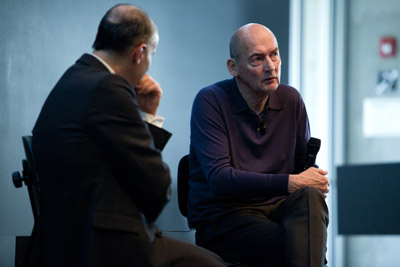
Koolhaas and Kleinman spoke March 9 to a capacity crowd in the 270-seat Abby and Howard Milstein Auditorium and Boardroom.
Koolhaas' informal presentation was an offhand autobiographical sketch. Being born in Rotterdam during WWII was "the ideal moment for an architect," he said. He moved with his parents to Indonesia at age 8; decided at age 19 to be a journalist (a slide of a student newspaper photo showed him walking with film director Federico Fellini) and in 1968 became an architect in Berlin, discovering the work of Cornellians O.M. Ungers and Peter Eisenman '54, B.Arch. '55.
During the Q&A after his talk, Koolhaas defined education as "anything you need to know that is not on a laptop."
Alumni were impressed with the building, which has access from both Sibley and Rand halls.
"It connects all the parts of my Cornell experience in a meaningful way," said landscape architect Brian Grubb '89, B.Arch. '92. He added that "stairways to nowhere" and dead space between the buildings had been transformed by the project, and that "the scheme is preservationist."
Emeritus professor John Reps, M.R.P. '47, gave a talk March 10 (with assistance from planning professor Michael Tomlan) on research into the origins of the city plan for Savannah, Ga., which remained a mystery until Reps and Edmund Bacon, B.Arch. '32, Martha Pollak, B.Arch. '75, and Mark Reinberger, M.A. '82, Ph.D. '88, helped bring that history to light.
Everyone dressed to the nines for an evening dance party March 10 in the former Fine Arts Library space in Sibley Dome and the first-floor Milstein dome. The weekend also featured exhibitions by Simon Ungers '80 and Anthony Ames (continuing through March 30) and sales of Dragon Day T-shirts and college publications such as current and back issues of the Cornell Journal of Architecture, revived last year.
Media Contact
Get Cornell news delivered right to your inbox.
Subscribe