Choreographer challenges audience assumptions
By Elisabeth Rosen
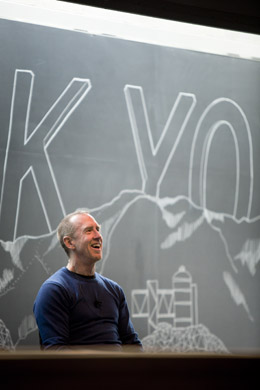
Think of a dance performance and certain images come to mind. Choreographer and A.D. White Professor-at-Large William Forsythe aims to turn those assumptions upside down. His latest work, "Nowhere and Everywhere at the Same Time" -- performed in Rand Hall this past week -- is a three-hour piece that challenges the traditional relationship between audience and performer.
"While you're in there you might contemplate, what part of the performance aren't I?" Forsythe said March 10 in a public conversation with Society for the Humanities Director Timothy Murray in Milstein Auditorium. "You're at the same level as the performer, there's maybe a few feet separating you. He's very aware of people's concentration quality. That's a big part of this performance. You're not invisible at all."
Unlike traditional choreographers who create a dance and treat it as a finished product, Forsythe directs each of his performances a little differently.
"They're living breathing things," he said. "It's not finished. I take into account the audience. I can speed up or slow down performances -- it's exciting!"
In "Nowhere," Forsythe addressed the question of what makes a choreographic object.
"If you hold a feather duster, you realize that you are vibrating the entire time. It tells you something about yourself physically. That's what makes something a choreographic object," he said. "You're looking at how you move unconsciously, and you try to engage with that."
He also drew a distinction between choreography and dancing. While "choreography is an organizational skill," dancing is about "accumulating expertise in difference."
"A life in dancing is an accumulation of sensitivities to very small differences," he said. "Dancers are expert at turning sensation into a form of visualization."
To demonstrate this point, he had the audience make two different hand gestures indicating a point and a line.
"You can see it, can't you?" he said. "But you can't. Dancers could give this invisible, fictive thing qualities, like elasticity, tension."
In the case of "Nowhere," the qualities that the dancer invests in the dance include sound. Forsythe recounted how Brock Labrenz, the dancer performing the piece, discovered that the wood and concrete floor of Rand Hall would be ideal for making noise. While most people wouldn't think of emphasizing sound creation in a dance piece, Forsythe's goal is to "mess with" the viewer's assumptions.
"Is a dance piece a sound piece?" he asked. "I think it's kind of hard to make sound without motion."
Performing the same dance in different spaces can yield intriguing results, he said, although some spaces just don't end up working. One space that didn't work was a turbine room -- although Forsythe said this failure was due to audience expectations as well as physical limitations.
"They had announced it as a performance that had a beginning and an end, so everyone was expecting a standard type of performance," he said. "And it ain't that."
Elisabeth Rosen '12 is a writer intern for the Cornell Chronicle.
Media Contact
Get Cornell news delivered right to your inbox.
Subscribe