New Becker House dean listens to the voices of the present and past
By Susan Kelley
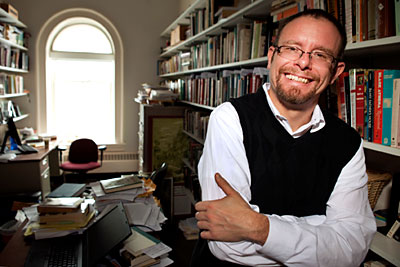
Professors are known for their ability to talk. Associate professor of history Ed Baptist knows the value of listening, too.
Before he came to Cornell in 2003, Baptist was the Charlton Tebeau Professor of History at the University of Miami, where he lived for two years in an undergraduate residence hall.
That experience taught him the importance of being available to sit with a student and willing to listen, said Baptist. "Even if it doesn't seem like they're talking about anything that they think is significant, talking matters. ... Students know when somebody is participating. They know when somebody is engaged and committed. And they know when somebody is not."
Baptist will apply those lessons this fall as the new house professor-dean of Carl Becker House. The house is part of the West Campus House System, which comprises five living/learning communities for upper-level students. According to Vice Provost Laura Brown, "West Campus provides our students with many unique ways of getting to know their professors, as people, as teachers and as scholars and researchers. Ed Baptist will be a terrific resource in supporting the mission of the West Campus House System, and in bringing his admirable talents and abilities to the leadership of Becker House." Baptist will move to the house this summer with his 12-year-old daughter, 9-year-old son, an elderly cat and a hound dog.
After growing up in North Carolina, Baptist earned a B.S. in foreign service from Georgetown University in 1992 and a Ph.D. from the University of Pennsylvania in 1997. He taught at the University of Miami from 1998 to 2003.
He will succeed current house professor-dean Cindy Hazan, associate professor of human development, who was Becker House's first professor-dean and has served in that role since 2005.
As Becker House's intellectual and cultural leader, Baptist hopes to build on Hazan's foundation by expanding the network of artists who regularly take part in house activities and dinners as faculty fellows. "Selfishly, I want my children to be exposed to the arts and artists, and I do too," he said. "Students are also very receptive to the arts, but they have to be accessible, so students don't have to hunt them down. And it's even better if the arts are in their living space, literally."
He also plans to gauge students' interest in developing a service project, as residents of William Keeton House have done. With the guidance of house professor-dean Jeff Cowie, last year they built a greenhouse out of recycled soda bottles for the Ithaca Children's Garden in Cass Park. "Not every student is going to participate in the same way, but you want them to have opportunities for that kind of engagement," Baptist said.
A historian who studies slavery in the 19th-century United States and how it shaped the country at that time, he also has ideas for new programming related to history, activism, social justice, economics and policy.
For example, a walking tour of Ithaca, which has avoided the decline that most former industrial towns have experienced, might make students think about the issues that the United States faces and understand how complex they are, he said. "We can't just assume that the stock market will improve and all our problems will go away. The problems that Tioga County is facing, for example, will not go away. I don't have the solution, but a lot of Cornell students could help."
Baptist plans to take the same approach to any house programming: expose the students to the primary and secondary sources and let them question the interpretations. "More than anything, I try to show them that it is important that we engage in these debates, that we don't let our right to civic and political engagement pass us by, that we don't let the decisions be made by others while we just entertain ourselves. That's more important than holding a particular point of view."
Get Cornell news delivered right to your inbox.
Subscribe