Light in Winter features almost two dozen events, including discussions about bonding with wild wolves
By Kate Neafsey

Seven-year-old Benjamin Charoenkajonchai watches a magic trick at the math and puzzles area, part of the Hall of Wonders event in Statler Hall's Beck Atrium.
Imagine encountering a wolf while walking in the woods. Would you be fearful or fascinated? What if the wolf were on a leash?
Thirteen years ago, Ron Riddle, a composer and former Blue Oyster Cult drummer, and his wife, Andrea, adopted Chance, an 18-month-old timber wolf slated to be euthanized at their local SPCA. At a Light in Winter event Jan. 24 in Statler Auditorium, they recounted how they became part of an "interspecies pack."
The presentation was one of almost two dozen Light in Winter events, Jan. 21- 24, held at a variety of venues. More than half the events were held on the Cornell campus and involved Cornell scientists, including Jody Enck, a research associate in natural resources, who described different attitudes people have toward sharing their natural environments with wolves at the "Living with Chance" presentation.
When the Riddles met Chance, he had been neither socialized by wolves nor humans. He was "a wild thing that was in a cage," said Andrea, but she and Ron were "both struck with the same feeling, which was 'we've got to get him out of here.'"
So they cleared the adoption with the SPCA and took the wolf home. Within hours, Chance had ripped up their couch, jumped on the kitchen table and woke the Riddles in the middle of the night by chewing on their heads. "If we had thought about what we were doing, we wouldn't have done it," Andrea said.
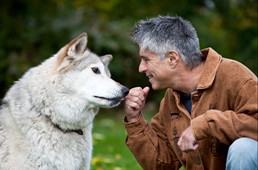
Ron Riddle, a composer and former Blue Oyster Cult drummer, bonds with his adopted timber wolf, Chance.
But, while most people might have been terrified, Ron explained, "We knew that he wasn't out to kill us -- he was just a really bad boy."
So the Riddles consulted with a wolf behaviorist and an online wolf support group to better understand Chance's behavior and to learn to communicate with him. After trying various socialization techniques -- from Ron donning a furry suit and wrestling with Chance to Andrea spitting chewed food into Chance's mouth in an attempt to get him to accept her as his mother -- the Riddles eventually created their own interspecies pack full of love and understanding.
These days, Chance at age 14 suffers from arthritis, has lost his howl and "sleeps on the couch instead of eating it." When the Riddles introduced Chance to the audience, he appeared mellow, though understandably a bit intimidated by the crowd.
While the Riddles have successfully merged the lives of two humans and a wolf, the Riddles and Enck discussed whether the Riddles should serve as a model for others or if wild predators should stay wild?
In his discussion about his research on people's attitudes toward the idea of reintroducing wolves into the Adirondack Park, Enck said, "When confronted with living with wolves [in the natural environment], real people have real hopes and dreams and real fears."
As for the Riddles, "It was never our intention [to adopt Chance], nor do we believe that wolves should be pets," said Andrea. "We only responded because Chance was going to be killed."
If nothing else, the Riddles would like their experience to demonstrate that wolves are, as Andrea put it, "all about family and loyalty -- not the ferocious demons we make them out to be."
Graduate student Kate Neafsey is a writer intern at the Cornell Chronicle.
Media Contact
Get Cornell news delivered right to your inbox.
Subscribe