Truman Capote Trust funds creative writing lectureship
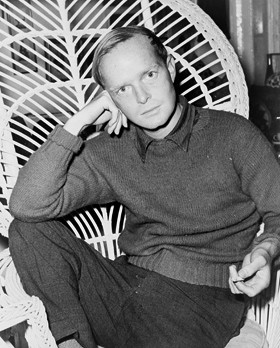
Truman Capote
The effect of Truman Capote's passion for the written word did not end with his death in 1984, as evidenced by the Truman Capote Trust's $30,000 grant to the Cornell English department for a Truman Capote Lectureship in Creative Writing.
"During these difficult financial times in our country, this grant will allow a graduate student to have a semester to work on his or her writing without having to worry about employment or moving from campus," said Helena Viramontes, director of the graduate creative writing program.
Alan Schwartz '53, Capote's lawyer and an administrator of the trust, explained that the writer's original intention had been to establish a $30,000 prize for literary criticism, comparable to the Pulitzer, in honor of his mentor and adviser, literary critic Newton Arvin. When Schwartz asked Capote what he wanted to do with the rest of his estate, Capote replied, "Are you crazy? I'm never going to have any more money."
Yet thanks to Alan and Louise Schwartz' careful stewardship of the trust, it was able to distribute a substantial number of scholarships to accredited institutions last year. The Capote Trust is funded by royalties, media sales and licenses, and does not accept unsolicited grant proposals.
"We want to support the best programs we can find," said Louise Schwartz. The Cornell grant was made, she explains, partly because "the Cornell program under Helena Viramontes' leadership has an excellent reputation."
The diversity in Cornell's creative writing program primarily impressed the Capote trustees. "This was an emphasis that we felt deserved to be rewarded," said Alan Schwartz.
Supporting underserved programs and minorities is a priority for the Capote Trust. Tacey Atsitty, now in her first year of the Cornell MFA Creative Writing Program, received a Truman Capote scholarship while at the Institute of American Indian Arts, an accredited Native American tribal college. "It was only because of the Truman Capote scholarship that I was able to finish a bachelor of fine arts in creative writing," Atsitty said, a degree that qualified her for Cornell's graduate program. She plans to return to the Navajo Nation to teach creative writing when she finishes her degree.
Capote would no doubt approve. As he once said during an interview with the Paris Review, "Writing has laws of perspective, of light and shade just as painting does, or music. If you are born knowing them, fine. If not, learn them. Then rearrange the rules to suit yourself."
Media Contact
Get Cornell news delivered right to your inbox.
Subscribe