Renowned economist defends the 'dismal science'
By Farrah Tan
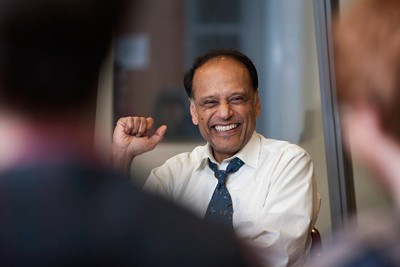
World renowned economist Partha Dasgupta visited with students at Bethe House Feb. 4 as part of his first trip to campus as an A.D. White Professor-at-Large.
Economics may be known as "the dismal science," but that's because any profession as influential as economics will have its cynics, said Partha Dasgupta, speaking informally to students on West Campus Feb. 4. on his first visit to campus as an A.D. White Professor-at-Large.
"Some get impatient. Others don't understand us," said Dasgupta, the Frank Ramsey Professor of Economics at the University of Cambridge in the United Kingdom. "You mustn't think that economics is completely homogeneous. There are quite a number of economists, some of the best economists, who are very critical of the direction in which macroeconomics, for example, has taken the past 30 years."
His informal talk at Hans Bethe House, where he stayed while on campus Jan. 31-Feb. 6, on the lure of economics attracted about 20 students, studying disciplines ranging from economics and engineering to British film.
Dasgupta said that he went into economics without any grand agenda for improving the world -- he simply wanted to pursue his interest and curiosity in solving intellectual problems. He originally studied theoretical physics at the University of Delhi but felt that high energy physics was a bit dull. He went on to obtain a degree in economics at Cambridge. Over the course of his career, he found biological principles to be more useful than his physics background.
Dasgupta has published 22 books and more than 200 papers on many aspects of economics, including welfare and development economics, the economics of technological change, and resource economics and management.
"Most of my best papers have been jointly authored," he noted. "They came out of friendships, the short glass-of-wine chatting, and then one of us independently writes down a model, explores it, passes it on ... and then before we know what's happening, we've written a paper. The process of writing the papers created a long enduring relationship. I have been very fortunate with that."
An exchange student from Italy's Bocconi University studying applied economics and management asked how an economist can help politics and society in his own country. "Do seriously important work on health, education or transportation, which have a very strong public side to them and big public investments," Dasgupta responded. "Then if you do very useful work on those applied areas, you're inevitably going to be called upon."
Rishi Khullar '12, a mathematics/economics major, said, "I'm from two backgrounds that tend to be grouped together, but they are not necessarily complementary. The professor's talk helped to resolve that the two don't have to coexist. Their conflict breeds natural creation."
While visiting campus Dasgupta also met with students from Ecology House, spoke to the student-run International Affairs Review and gave a public lecture on "Nature's Role in Sustaining Economic Development."
There are currently 17 active A.D. White Professors-at-Large who visit campus periodically to give formal lectures and to work with faculty and students in lectures, classes and outreach programs.
Farrah Tan '10 is a writer intern for the Cornell Chronicle.
Media Contact
Get Cornell news delivered right to your inbox.
Subscribe