New book explores social costs of digital rights management
By Susan S. Lang
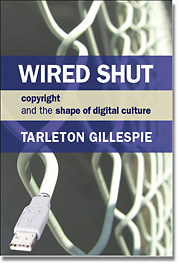
Copyright law was conceived when only a few people had the ability to mass-produce intellectual property. Computers and the Internet, however, have opened a whole new can of worms, allowing almost anyone to copy almost anything and distribute it widely. Instead of relying on the enforcement of copyright laws, more and more industries are relying on such technologies as encryption to protect their content.
Copyright law was conceived when only a few people had the ability to mass-produce intellectual property. Computers and the Internet, however, have opened a whole new can of worms, allowing almost anyone to copy almost anything and distribute it widely. Instead of relying on the enforcement of copyright laws, more and more industries are relying on such technologies as encryption to protect their content.
In his first book, "Wired Shut: Copyright and the Shape of Digital Culture" (MIT Press), Tarleton Gillespie, Cornell assistant professor of communication and information science, explores the profound political, economic and cultural implications of using "technical copy protection" to do the work that copyright laws did before the digital age.
He explores, for example, how such industries as music and film are forging new alliances with legislators, regulators, the courts and their content authors to protect their digital material. In the process they are increasingly commercializing culture and regulating communication and "threatening to undermine the democratic potential of a network society," says Gillespie.
In his first chapter, which serves as an introduction to the book and is available online in full, Gillespie writes that his book looks beyond standard legal critiques of copyright by exploring recent theories of technology, communication and culture to consider broader ramifications. Digital copyright, he says, is the perfect place to look at how we use the mechanisms of law, technology and the marketplace to structure cultural expression, and how the outcomes of today's controversies concerning digital copyright will largely shape the future of digital culture.
The book examines three examples in detail -- the failure to develop copy protection for portable music players, the successful encryption system used to protect DVDs, and the Federal Communications Commission's attempt to mandate copy protection systems in digital television.
"It ['Wired Shut'] reveals a crossroads faced by a society embracing technologies that can both facilitate digital culture and be made to regulate it," Gillespie writes in concluding his first chapter. "The choices we make now will help decide whether we will be active participants in our culture and creative users of our technology, or passive recipients content to quietly embrace what is sold to us and fulfill the roles prescribed for us."
"'Wired Shut' is an important book, essential for those who care about the future of digital technologies and information flows," says Pamela Samuelson, the Richard M. Sherman Distinguished Professor of Law and Information at the University of California-Berkeley. "The societal implications of digital rights management [DRM] technologies have never been explored this deeply or comprehensively. DRM technologies are neither technological nor economic imperatives, and Gillespie shows that their social costs are avoidable."
Media Contact
Get Cornell news delivered right to your inbox.
Subscribe