Asian or American? Internment story told through art
By Sushmitha Krishnamoorthy
A photograph of three children in military poses holding imaginary guns is projected on the screen. One of the children is Roger Shimomura, a third-generation Japanese-American, playing “Kill the Japs” with two other boys in an internment camp during World War II.
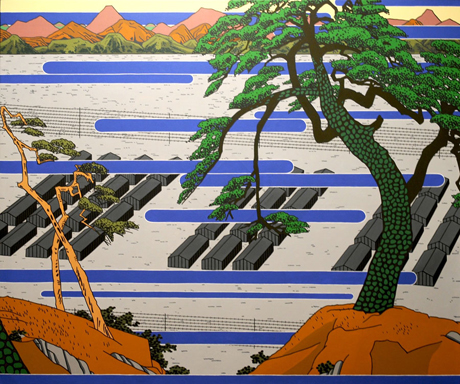
Shimomura, an artist and retired professor at Kansas University who spent two years of his early life at the Minidoka Relocation Center in Idaho during World War II, said in a Sept. 19 talk at the Herbert F. Johnson Museum of Art that his work addresses sociopolitical issues of ethnicity.
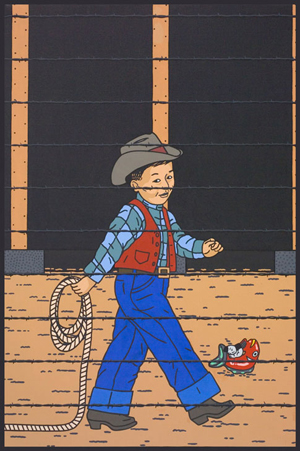
“Minidoka on My Mind,” his series of paintings depicting life at an internment camp, is on display at the museum. The exhibition and talk were held in conjunction with the 2013 New Student Reading Project, a campuswide reading of Julie Otsuka’s novel, “When the Emperor Was Divine.”
Recalling his family’s experience at the camp, Shimomura said the authorities “were in such a rush to get us into the camps and out of our homes that they put us in assembly centers.” His family was placed in horse stalls at the Puyallup State Fair Grounds for three months, he said, noting, “They gave us cots of gunny sacks and put straw in them to use as mattresses.”
Shimomura was only three years old when his family was interned, and most of the inspiration for the Minidoka series came from his grandmother’s diaries, which were in Japanese.
His grandmother’s earlier diaries had been destroyed by his mother, he said. “People were getting locked up for having diaries as they had a kind of sentimental reference to Japan.”
One painting Shimomura discussed showed him and his mother with a guard tower in the background and his grandmother writing in the foreground. “She kept a diary throughout the camp, and this is homage to her doing that,” he said.
In another series depicting life at the internment camp, Shimomura used lines from his grandmother’s diary for themes such as:

“I cannot believe we are expected to live here.”
“Today, I did laundry, I cleaned the room. We lead a boring life.”
“The Japanese are outside the barbed fences. The Japanese-Americans are inside.”
Shimomura also discussed his works addressing stereotypes of Asians and Asian-Americans and his current series, “The American Knockoff.” These paintings focus on the evolution of Japanese-American culture over three generations, interracial marriages, fighting racial stereotypes, stereotypes found in popular comics and the idea of being “eternal foreigners.”
“Minidoka on My Mind” is on display at the Johnson Museum until Dec. 22. The exhibition was curated by Ellen Avril, chief curator and curator of Asian art at the museum.
Sushmitha Krishnamoorthy ’17 is a writer intern for the Cornell Chronicle.
Media Contact
Get Cornell news delivered right to your inbox.
Subscribe